Sale!

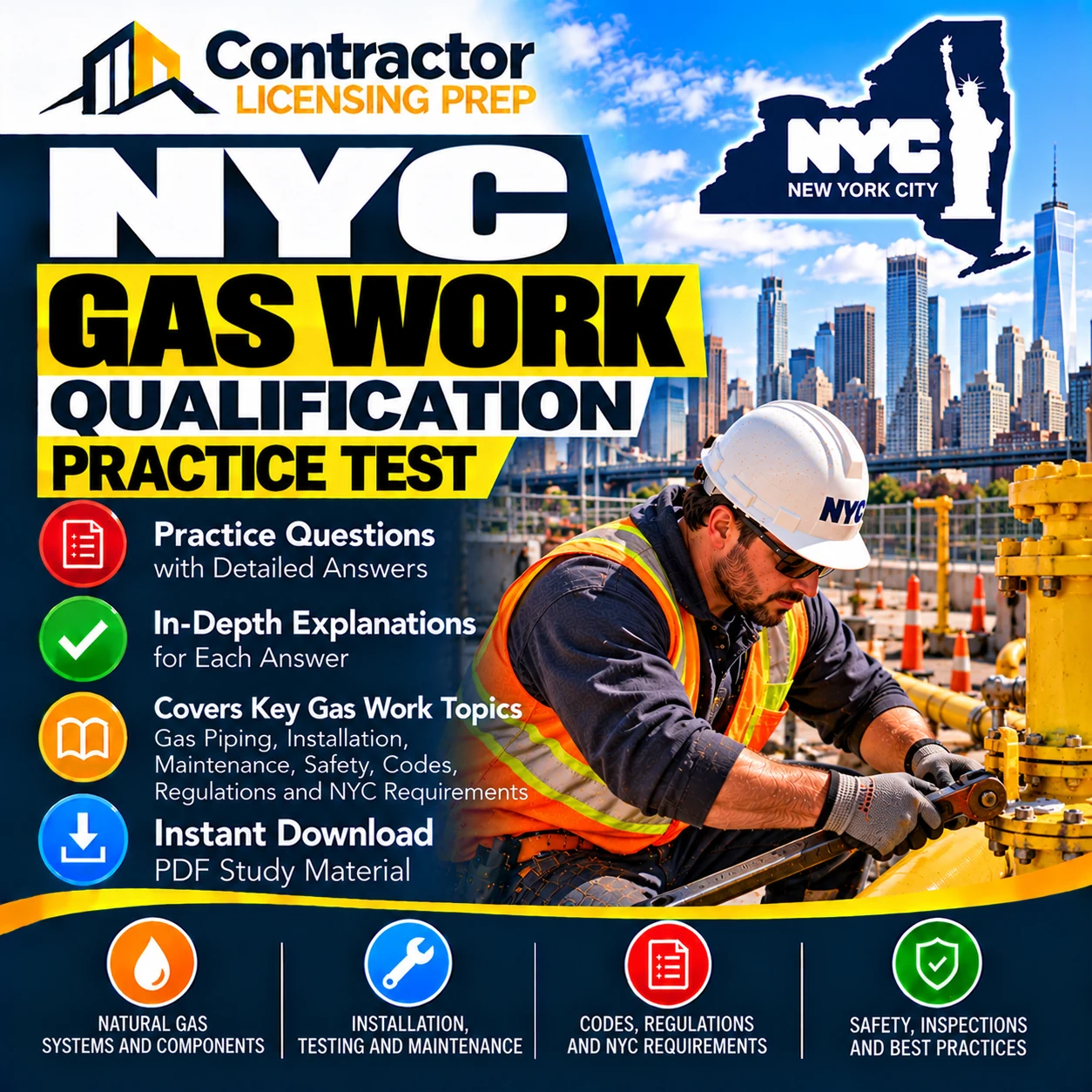
NYC Gas Work Qualification Practice Test

✓ 750 Questions and Answers (Instant PDF Download)

Original price was: $59.95.Current price is: $39.99.

Ready to Get Full Access?

Get the complete practice test with detailed answer explanations and prepare at your own pace.

Original price was: $59.95.Current price is: $39.99.

NYC Gas Work Qualification Practice Test helps candidates prepare for the New York City Department of Buildings (NYC DOB) Gas Work Qualification examination with practical questions, detailed answer explanations, and code-focused study material. Gas work requires more than knowing how to install pipes and connect appliances. Candidates must understand gas detection, pressure testing, utility procedures, combustion safety, applicable NYC codes, and the hazards that can arise when gas systems are installed or serviced incorrectly.

Whether you are preparing for a Full Gas Work Qualification or strengthening your knowledge of NYC gas piping requirements, this practice test provides a structured way to review essential technical subjects. Work through realistic scenarios involving leak detection, testing procedures, gas piping, safety violations, and emergency response to develop a stronger understanding of the decisions expected in professional gas work.

Start preparing today with focused NYC Gas Work Qualification practice questions. Strengthen your code knowledge, improve your safety judgment, and build confidence before your qualification examination.

Prepare for the NYC Gas Work Qualification Exam

New York City has specific requirements governing who may perform gas work. Under the applicable rules, individuals must hold the required Department-issued qualification or an appropriate Master Plumber license to perform covered work.

Gas work can involve significant hazards, including gas leaks, fire, explosion, carbon monoxide exposure, and unsafe appliance operation. Proper testing, code compliance, and safe work procedures are essential to preventing these risks.

This NYC Gas Work Qualification practice test helps you review the major subject areas associated with the examination, including:

  • Gas detection and testing procedures
  • Common utility processes and procedures
  • Gas piping installation and pressure testing
  • Gas Work Qualification rules and business practices
  • Gas work safety and hazard recognition
  • NYC Fuel Gas Code and Plumbing Code requirements
  • Gas regulators, shutoff valves, and piping connections
  • Purging procedures and leak investigation
  • Combustion air and appliance venting
  • Gas piping modifications and appliance additions
  • New gas technologies and specialized applications
  • Unsafe conditions, code violations, and corrective actions

These topics provide a practical foundation for understanding the regulatory and technical responsibilities associated with gas work in New York City.

What Makes This Gas Work Practice Test Useful?

Gas work questions often require candidates to identify the safest and most code-compliant response to a particular situation. For example, a suspected leak may require a different response from a failed pressure test, an improperly installed shutoff valve, or an appliance with inadequate combustion air.

This practice test helps you evaluate your understanding through scenario-based questions and detailed explanations.

Identify knowledge gaps: Find the subjects that require additional review, including gas testing, safety procedures, and code requirements.

Strengthen technical reasoning: Practice evaluating gas piping conditions, testing results, equipment arrangements, and potential hazards.

Improve code familiarity: Review the principles behind NYC Fuel Gas Code, NYC Plumbing Code, and other applicable requirements.

Recognize unsafe conditions: Learn to identify situations that may lead to leaks, improper combustion, fire, or other serious hazards.

Understand the correct response: Study why a particular action is appropriate and why alternative choices may create additional risks.

Prepare for open-book testing: Develop a more efficient approach to locating and applying information from permitted electronic references.

The emphasis is on understanding the reasoning behind each answer rather than memorizing isolated facts.

What Is the NYC Gas Work Qualification Exam?

The NYC Gas Work Qualification examination is administered through the city’s Department of Buildings licensing and qualification process. It evaluates a candidate’s understanding of the applicable codes, regulations, and practical safety principles governing gas work.

The official examination outline identifies six principal subject areas: Gas Detection Testing, Common Utility Processes and Procedures, Gas Work Business Practices, Gas Work Safety, Gas Work New Technology, and Gas Work Hazards and Violations.

The written examination is open book. However, the reference materials specified in the official candidate bulletin are provided electronically through the testing platform. Candidates cannot bring their own reference books into the testing center.

Preparation should therefore involve both learning the technical requirements and practicing how to locate relevant information efficiently. Candidates should review the current NYC DOB candidate bulletin for the examination format, approved references, eligibility requirements, application procedures, and scheduling instructions.

This practice test is an independent study resource and is not an official NYC DOB examination or a guarantee of passing.

Review the Core Topics Covered on the Gas Work Exam

Gas Detection and Testing

Gas detection and testing are central to safe gas-system installation and maintenance. Review the purpose of pressure tests, appropriate test procedures, leak detection methods, testing equipment, and the steps required before a system is placed into service.

Practice interpreting scenarios involving a failed test, suspected leakage, or a connection that has not been verified. Understand why the prescribed testing procedure must be completed before the system is commissioned.

Common Utility Processes and Procedures

Gas work frequently involves service connections, meter arrangements, piping modifications, regulators, shutoff valves, and appliance installations. Candidates should understand how these components work together and how applicable code requirements govern their installation.

Study the relevant requirements for service arrangements, gas piping, appliance additions, and other utility-related procedures. Pay attention to conditions that require additional testing, approval, or corrective work.

Gas Work Safety and Hazard Recognition

Gas hazards require prompt recognition and an appropriate response. Review procedures for suspected leaks, ignition-source control, emergency shutdowns, ventilation, and communication with responsible personnel.

Understand how improper piping, inadequate combustion air, defective venting, and unsafe testing methods can create dangerous conditions. When a situation presents an immediate hazard, the appropriate response is to protect people and follow established emergency procedures rather than attempt an improvised repair.

Business Practices and Qualification Requirements

Candidates should understand the distinction between Full and Limited Gas Work Qualification, including the applicable supervision requirements and restrictions.

Review the responsibilities associated with performing authorized work, following licensing rules, maintaining appropriate documentation, and complying with the requirements applicable to the work being performed.

New Technology and Specialized Gas Systems

The examination also addresses newer or specialized gas-system concepts identified in the official outline. Candidates should review the applicable provisions concerning gas-system technologies, specialized applications, and associated safety requirements.

Use the current examination references to establish which technical provisions apply rather than relying on assumptions based on older installations.

Who Should Use This NYC Gas Work Practice Test?

This practice test is suitable for:

  • Candidates preparing for the NYC Gas Work Qualification examination
  • Individuals pursuing Full Gas Work Qualification
  • Eligible plumbing and gas-work professionals reviewing NYC requirements
  • Candidates strengthening their knowledge of gas testing and leak detection
  • Workers reviewing fuel gas safety and installation practices
  • Applicants who want additional practice with code-based scenarios

It can also help experienced professionals identify subjects that need additional study before the examination.

Eligibility requirements differ between qualification pathways. Candidates should verify the applicable education, training, experience, supervision, and application requirements before scheduling the test.

How to Study for the NYC Gas Work Qualification Exam

Begin by reviewing the official examination outline and organizing your study sessions around its six subject areas. Give particular attention to gas detection and testing, common utility procedures, safety, and hazards and violations.

Work through practice questions before reviewing the answers. When you miss a question, identify the underlying code requirement or safety principle and consult the appropriate reference. Avoid memorizing a correct option without understanding why it applies to the situation.

Because the examination is open book, practice navigating the permitted electronic references. Learn how code provisions are organized and become comfortable identifying relevant sections without spending excessive time searching.

Pay special attention to pressure testing, leak investigation, appliance connections, combustion air, venting, and unsafe conditions. These subjects require careful judgment because an incorrect procedure can create serious safety risks.

Get Ready for Your NYC Gas Work Qualification Examination

Preparing for the NYC Gas Work Qualification examination requires a combination of code knowledge, practical understanding, and sound safety judgment. Focused practice can help you identify weaknesses, reinforce important requirements, and approach technical scenarios more confidently.

The NYC Gas Work Qualification Practice Test provides a structured way to review gas detection, testing procedures, utility processes, business practices, safety requirements, emerging technologies, and common code violations. Detailed answer explanations help you understand the reasoning behind each answer and make your preparation more effective.

Begin your preparation today. Practice realistic gas work scenarios, strengthen your understanding of NYC code requirements, and take a more focused approach to your Gas Work Qualification examination.

Description

Sample Questions

Question 1. During gas work, a technician suspects a leak at a piping connection. Which action should be taken first?

A. Tighten the connection while the gas supply remains active
B. Apply pipe sealant to the suspected area
C. Follow the applicable emergency procedures, control ignition risks, and secure the area
D. Continue the work and inspect the connection after completion

Correct Answer: C. Follow the applicable emergency procedures, control ignition risks, and secure the area

Answer Explanation:
A suspected gas leak presents an immediate fire, explosion, and exposure hazard. The technician should follow the applicable emergency procedures, avoid actions that could create an ignition source, and protect people in the affected area. The gas supply should be isolated when safe and appropriate under the established procedure, and the responsible utility or emergency service should be contacted as required. Repairs must not begin until the hazard has been controlled and the area has been made safe. The correct response prioritizes life safety and proper hazard control rather than attempting an immediate repair.

Why the other options are incorrect:
A. Tightening a connection while gas is flowing may worsen the leak or create additional risks.
B. Applying sealant is not a substitute for leak isolation and approved repair procedures.
D. Continuing work exposes personnel and property to an unnecessary hazard.

Quick Study Guide:
Treat suspected gas leaks as urgent safety hazards.
Control ignition sources and protect people in the affected area.
Follow approved emergency and isolation procedures.
Resume work only after the hazard is controlled.

Question 2. A gas piping installation has been completed, but the required pressure test has not yet been performed. What should the technician do before placing the piping into service?

A. Perform the required test using the approved procedure and acceptance criteria
B. Open the gas supply briefly to check whether the appliances operate
C. Inspect only the visible joints and proceed if they appear secure
D. Ask the building occupant to report any gas odor after startup

Correct Answer: A. Perform the required test using the approved procedure and acceptance criteria

Answer Explanation:
A required pressure test helps establish whether the piping system meets the applicable integrity requirements before it is placed into service. The technician must use the prescribed test medium, pressure, duration, instruments, and acceptance criteria specified by the governing code and approved procedure. The system must be isolated and prepared correctly, and the results should be documented when required. Visual inspection alone cannot establish that a piping system passes its required test. Likewise, operating appliances or relying on occupants to detect odors is not an acceptable replacement for formal testing and verification.

Why the other options are incorrect:
B. Operating the system before completing required testing bypasses an important safety verification.
C. A visual inspection cannot replace the prescribed pressure test.
D. Occupant observations are not a technical test or proof of system integrity.

Quick Study Guide:
Know the difference between visual inspection and pressure testing.
Review the applicable test pressure, duration, and acceptance criteria.
Use suitable instruments and approved procedures.
Document test results whenever required.

Question 3. During an inspection, a technician discovers that installed gas piping does not match the approved installation documents. What is the most appropriate response?

A. Make the discrepancy part of the maintenance notes and continue
B. Accept the installation if no leak is detected
C. Cover the piping before the inspection deadline
D. Determine whether the change is permitted, resolve the discrepancy, and obtain required approval before proceeding

Correct Answer: D. Determine whether the change is permitted, resolve the discrepancy, and obtain required approval before proceeding

Answer Explanation:
An installation that differs from its approved documents requires evaluation before the work can be accepted. The technician should identify the discrepancy, check the applicable code and project requirements, and determine whether revised documents, additional inspection, or authorization is necessary. If the installation is noncompliant, it must be corrected through an approved process. The absence of a detectable leak does not establish compliance with all requirements, which may also address piping materials, sizing, routing, supports, clearances, and other safety considerations. Proper documentation and authorization help ensure that the final installation meets the applicable requirements.

Why the other options are incorrect:
A. Recording a discrepancy does not resolve a potential compliance issue.
B. Leak-free piping may still violate installation requirements.
C. Concealing piping before resolving the issue may obstruct inspection and corrective work.

Quick Study Guide:
Compare completed work with approved documents.
Identify code and permit requirements before accepting changes.
Obtain required approvals and inspections.
Keep installation records accurate and complete.

Question 4. A technician is preparing to purge air from a gas piping system. Which consideration is most important before starting the procedure?

A. Increase the gas flow as much as possible to shorten the job
B. Follow the approved purging procedure, including ventilation, ignition control, and safe discharge arrangements
C. Discharge the gas-air mixture into any convenient indoor space
D. Begin purging before notifying affected personnel

Correct Answer: B. Follow the approved purging procedure, including ventilation, ignition control, and safe discharge arrangements

Answer Explanation:
Purging can release a combustible gas-air mixture, creating fire, explosion, and exposure hazards if performed incorrectly. Before starting, the technician must follow the applicable code and approved procedure, establish appropriate ventilation and discharge arrangements, control ignition sources, and protect people who could be affected. The procedure must account for the system configuration, the gas involved, and the conditions at the work location. Purging should not be improvised to save time, and gas must not be discharged into an unsuitable occupied space. Required notifications, precautions, and verification steps should be completed before the operation begins.

Why the other options are incorrect:
A. Excessive flow can create additional hazards and may violate the approved procedure.
C. An indoor discharge can allow combustible gas to accumulate.
D. Failing to coordinate the work can expose others to an unexpected hazard.

Quick Study Guide:
Review the approved purging sequence and applicable code.
Control ignition sources and protect affected personnel.
Use safe discharge locations and adequate ventilation.
Never improvise a purging procedure.

Question 5. A technician finds that a gas appliance’s venting arrangement may allow combustion products to enter an occupied room. What should the technician do?

A. Increase the thermostat setting to improve appliance operation
B. Seal the room’s ventilation openings to prevent drafts
C. Stop or restrict operation as appropriate, assess the hazard, and arrange correction under applicable requirements
D. Leave the appliance operating and recommend a future inspection

Correct Answer: C. Stop or restrict operation as appropriate, assess the hazard, and arrange correction under applicable requirements

Answer Explanation:
Improper venting can expose occupants to combustion products, including potentially fatal carbon monoxide. The technician should assess the immediate danger, take appropriate steps to prevent continued exposure, and follow applicable emergency, shutdown, and notification procedures. The venting arrangement must be evaluated against the relevant code and manufacturer requirements, and any deficiencies must be corrected before the appliance is returned to service when required. The technician should not attempt to solve a venting problem by changing thermostat settings or blocking ventilation openings. Proper combustion-air supply, vent configuration, and safe discharge of combustion products are essential to safe appliance operation.

Why the other options are incorrect:
A. Changing the thermostat does not correct unsafe venting.
B. Blocking ventilation openings can worsen combustion and indoor-air hazards.
D. Continuing operation may expose occupants to dangerous combustion products.

Quick Study Guide:
Recognize unsafe venting and combustion-air conditions.
Understand the risks associated with carbon monoxide.
Follow applicable shutdown and corrective-action procedures.
Verify safe operation before returning equipment to service.

Ready to Download the Complete Practice Test?

Get the complete downloadable practice test with answer explanations and continue preparing at your own pace.
Original price was: $59.95.Current price is: $39.99.

Reviews

There are no reviews yet.

Be the first to review “NYC Gas Work Qualification Practice Test”

Your email address will not be published. Required fields are marked *

FAQs

What topics are covered in the NYC Gas Work Qualification Practice Test?

The NYC Gas Work Qualification Practice Test covers key exam areas, including gas detection testing, utility processes and procedures, gas work business practices, safety requirements, new technologies, and gas work hazards and violations. It also helps learners review relevant NYC gas work regulations and practical safety procedures.

Is this NYC Gas Work Qualification Practice Test suitable for first-time exam candidates?

Yes. This practice test is suitable for first-time candidates who want to build a strong understanding of gas work concepts before taking the qualification exam. It also helps experienced gas workers review important requirements, identify knowledge gaps, and strengthen their exam preparation.

How does the NYC Gas Work Qualification Practice Test help me prepare for the actual exam?

The practice test gives you an opportunity to work through exam-style questions, review your answers, and identify topics that require additional study. Practicing regularly can improve your understanding of gas work procedures, safety responsibilities, code-related requirements, and hazard recognition

Does the NYC Gas Work Qualification Practice Test cover safety and code-related questions?

Yes. It includes practice questions addressing gas work safety, hazard identification, testing procedures, regulatory compliance, and code-related concepts relevant to NYC gas work qualification. These areas help candidates prepare for questions involving safe work practices and compliance responsibilities.

What is the difference between the NYC Gas Work Qualification Practice Test and the official qualification exam?

The NYC Gas Work Qualification Practice Test is a study resource designed to help candidates review relevant subjects and assess their readiness. The official qualification exam is administered through the designated examination process and determines whether a candidate meets the applicable testing requirements. This practice test is not an official exam or a guarantee of passing.