Sale!

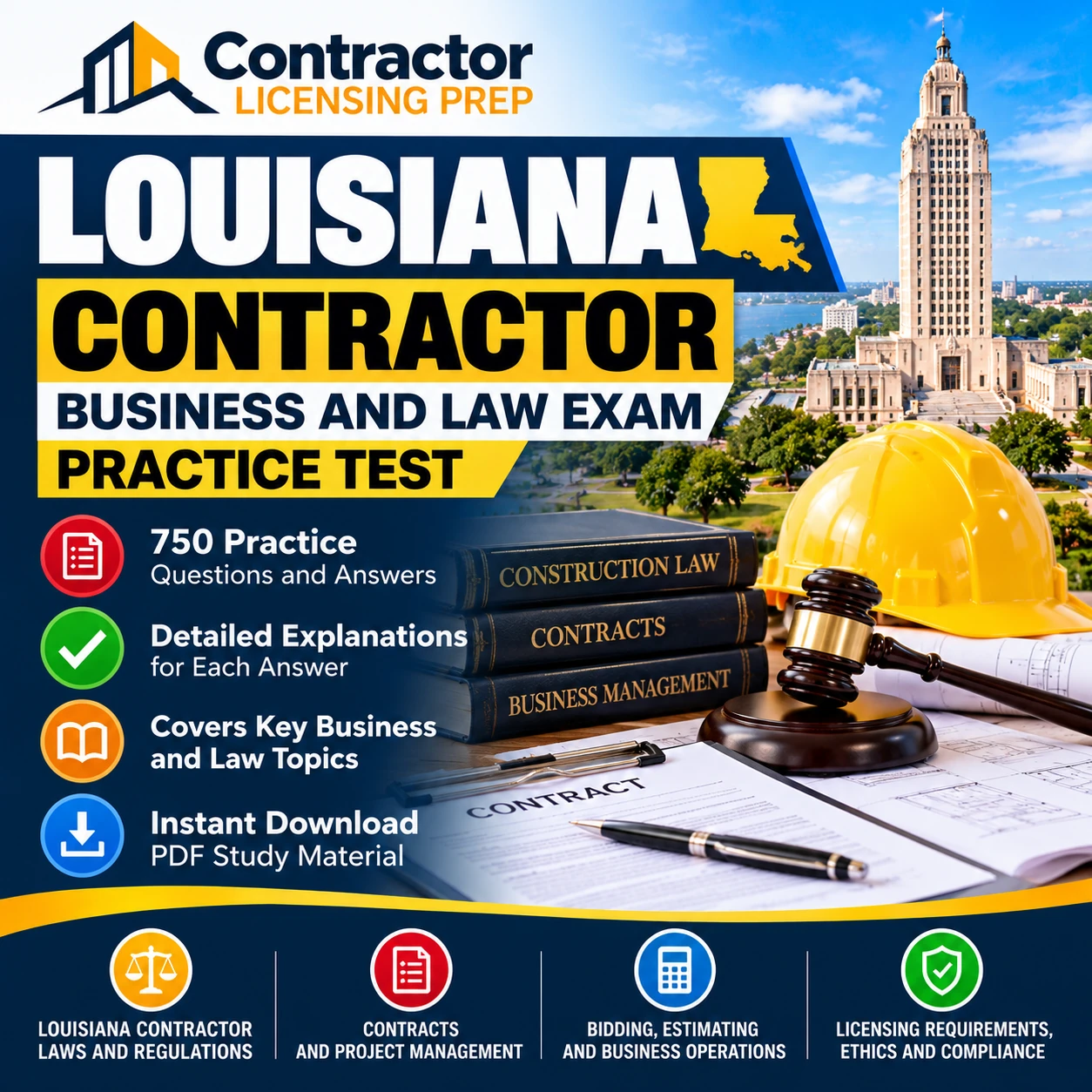
Louisiana Contractor Business and Law Practice Exam

✓ 750 Questions and Answers with Explanations ( Instant PDF Downloadable )

Original price was: $59.95.Current price is: $39.99.

Ready to Get Full Access?

Get the complete practice test with detailed answer explanations and prepare at your own pace.

Original price was: $59.95.Current price is: $39.99.

Sample Questions

Question 1. A Louisiana commercial contractor is finalizing a lump-sum bid. The estimator has $200,000 in direct job costs. Company policy adds overhead at 12 percent of direct costs. Management also requires a profit equal to 10 percent of the final selling price, not 10 percent of cost. Which bid price meets both requirements?

A. $246,400
B. $244,000
C. $248,889
D. $268,800

Correct Answer: C. $248,889

Answer Explanation:
Overhead and profit are layered onto direct cost in sequence. Overhead of 12 percent on $200,000 equals $24,000, which brings total cost to $224,000. Because profit is defined as a percentage of the selling price, cost must equal 90 percent of the price. The price is therefore $224,000 divided by 0.90, or about $248,889. A quick check confirms it: 10 percent of $248,889 is roughly $24,889, and adding that to $224,000 returns the bid price. Confusing markup with margin is one of the most common estimating errors, and it quietly shrinks profit on every job where it occurs.

Why the Other Options Are Incorrect:
A. $246,400 — Incorrect. This adds 10 percent to cost, which is a markup. The resulting profit is only about 9.1 percent of the selling price.
B. $244,000 — Incorrect. This adds 10 percent of direct cost, or $20,000, and leaves profit well below 10 percent of the price.
D. $268,800 — Incorrect. This applies a 20 percent markup to total cost, which overshoots the stated profit target.

Quick Study Guide:
Markup is a percentage of cost, while margin is a percentage of selling price. To reach a target margin, divide total cost by one minus the margin rather than multiplying by one plus the margin. Always add overhead first, then calculate profit. Practice converting between markup and margin, because exam wording often hides the difference.

Question 2. Marchand & Sons Builders, LLC holds its Louisiana contractor license under that exact legal name, which matches its Secretary of State registration. For marketing, the company uses the brand “Marchand Home Solutions” on trucks and websites. The office manager is preparing a commercial bid package, a contract, and the first invoice. Which practice is consistent with LSLBC licensing requirements?

A. Prepare the bid, contract, and invoice in the exact legal entity name shown on the license.
B. Use the brand name on all documents because customers recognize it.
C. Use either name, provided the license number appears somewhere on the documents.
D. Use the qualifying party’s personal name, since that person passed the examination.

Correct Answer: A. Prepare the bid, contract, and invoice in the exact legal entity name shown on the license.

Answer Explanation:
The LSLBC licenses a legal entity, not a brand. The name on the application becomes the name on the license, and it must be the same legal name registered with the Louisiana Secretary of State. That licensed name is the one to use on bids, estimates, contracts, and invoices so that the party legally responsible for the work is unmistakable. The Board does not treat a trade name or fictitious name as a substitute for the licensed entity. Marketing under a brand is a separate matter. Contract documents are where legal identity matters, because disputes, payment claims, and regulatory reviews all trace back to the named licensed party.

Why the Other Options Are Incorrect:
B. Use the brand name on all documents because customers recognize it — Incorrect. Recognition does not change which entity holds the license, and a brand name does not identify the licensed party.
C. Use either name, provided the license number appears — Incorrect. A license number does not make an unrecognized name acceptable on contract documents.
D. Use the qualifying party’s personal name — Incorrect. The qualifying party satisfies examination requirements for the entity but does not replace the entity’s licensed name.

Quick Study Guide:
A Louisiana contractor license belongs to the legal entity named on the application. Use that exact name on bids, estimates, contracts, and invoices. Brand names and DBAs do not replace it. Keep the Secretary of State registration current and consistent with the license, since a mismatch can create licensing and contract-enforcement problems.

Question 3. A general contractor’s subcontract requires the electrical subcontractor to carry commercial general liability insurance, name the general contractor as an additional insured, and provide coverage on a primary and noncontributory basis. Before mobilization, the subcontractor emails a certificate of insurance showing its policy limits and expiration date. The certificate lists the general contractor only as “certificate holder.” What should the general contractor’s project manager do?

A. Accept the certificate, since a certificate holder has the same rights as an additional insured.
B. Accept it and rely on the general contractor’s own policy for any claim.
C. Waive the requirement because the policy limits meet the contract minimum.
D. Require the actual additional insured endorsement and primary and noncontributory wording before work begins.

Correct Answer: D. Require the actual additional insured endorsement and primary and noncontributory wording before work begins.

Answer Explanation:
A certificate of insurance is evidence that a policy exists on a given date, but it generally does not amend the policy or grant coverage to anyone. Additional insured status is created by an endorsement to the subcontractor’s policy. Primary and noncontributory wording determines whose policy responds first and prevents the general contractor’s own insurance from being drawn into the loss. Listing the general contractor merely as certificate holder confers no coverage rights. The project manager should obtain the endorsements, review them against the subcontract, and hold mobilization until the gap is closed, because discovering the deficiency after a claim is far more expensive.

Why the Other Options Are Incorrect:
A. Accept the certificate, since a certificate holder has the same rights — Incorrect. A certificate holder is only notified of the policy’s existence and receives no insured status.
B. Accept it and rely on the general contractor’s own policy — Incorrect. This defeats the purpose of the risk transfer in the subcontract and may raise the general contractor’s own claim costs.
C. Waive the requirement because limits meet the minimum — Incorrect. Adequate limits do not substitute for the required insured status and coverage priority.

Quick Study Guide:
Certificates prove coverage exists; endorsements create rights. Additional insured status, primary and noncontributory wording, and waivers of subrogation all come from policy endorsements. Verify them against subcontract requirements before mobilization. Track expirations and renewals throughout the job so required coverage does not quietly lapse during construction.

Question 4. A contractor uses the cost-to-cost method to measure progress on a $500,000 contract. The current estimate of total job cost is $400,000. Costs incurred to date are $240,000, and the contractor has billed the owner $330,000 to date. What is the contractor’s position on this job?

A. Underbilled by $30,000
B. Overbilled by $30,000
C. Overbilled by $90,000
D. Underbilled by $60,000

Correct Answer: B. Overbilled by $30,000

Answer Explanation:
Under the cost-to-cost method, percent complete equals costs incurred divided by estimated total cost. Here that is $240,000 divided by $400,000, or 60 percent. Earned revenue is 60 percent of the $500,000 contract, which is $300,000. The contractor has billed $330,000, which exceeds earned revenue by $30,000, so the job is overbilled. Overbilling is a liability on the balance sheet because the contractor has collected or claimed more than it has earned. It improves short-term cash but signals an obligation to perform remaining work, and it deserves attention when estimates change.

Why the Other Options Are Incorrect:
A. Underbilled by $30,000 — Incorrect. The magnitude is right, but the direction is reversed. Billings exceed earned revenue, which means overbilling.
C. Overbilled by $90,000 — Incorrect. This subtracts costs incurred from billings, mixing cost with revenue instead of comparing billings to earned revenue.
D. Underbilled by $60,000 — Incorrect. This subtracts costs from earned revenue, which measures nothing useful for billing position.

Quick Study Guide:
Compute percent complete first, then earned revenue, then compare earned revenue to billings. Billings above earned revenue means overbilled; billings below means underbilled. Never compare billings to cost incurred. Watch how revised cost estimates change percent complete, since a higher estimate can turn an apparent overbilling into an underbilling.

Question 5. On a bonded public project, a material supplier delivered conduit and fittings to the electrical subcontractor. The subcontractor has not paid the supplier, and the project is nearing completion. The supplier asks which instrument most directly provides a source of recovery, assuming the supplier meets all applicable notice and claim requirements. Which answer is correct?

A. The performance bond
B. The bid bond
C. The payment bond
D. The general contractor’s commercial general liability policy

Correct Answer: C. The payment bond

Answer Explanation:
A payment bond guarantees that the contractor will pay those who furnish labor, materials, or equipment for the project. Qualifying unpaid claimants, which can include suppliers and subcontractors depending on their tier and the governing statute, may pursue the surety if they follow the required notice and filing procedures. Missing those deadlines can forfeit the claim, so timing matters as much as entitlement. A performance bond serves a different purpose: it protects the owner if the contractor fails to complete the work. A bid bond protects the owner at the bidding stage and does not address payment disputes on awarded work.

Why the Other Options Are Incorrect:
A. The performance bond — Incorrect. It protects the owner against the contractor’s failure to complete the contract, not suppliers’ payment claims.
B. The bid bond — Incorrect. It secures the bidder’s commitment to sign the contract at the bid price and has no connection to payment for delivered materials.
D. The general contractor’s commercial general liability policy — Incorrect. Liability insurance responds to third-party bodily injury and property damage, not to unpaid invoices.

Quick Study Guide:
Learn what each bond protects. Bid bonds secure the bid, performance bonds secure completion for the owner, and payment bonds secure payment for labor and material claimants. Claimants must follow strict notice and filing deadlines to preserve rights. Verify the applicable Louisiana public works requirements for timing, because a late notice can defeat an otherwise valid claim.

Description

Most contractors don’t struggle with the work. They struggle with the paperwork side of it: bid math, insurance wording, bond types, and the licensing rules that decide whether you can even bid the job. The Business and Law exam tests exactly that, and it doesn’t care how good you are with a crew.

This Louisiana Contractor Business and Law Exam Practice Test gives you 750 exam-style questions with correct answers and detailed explanations. Work through realistic job-site and office scenarios, find the gaps in your business knowledge, and fix them before you log in to take the real exam.

What Is Included in the Louisiana Contractor Business and Law Practice Test?

You get 750 multiple-choice questions with four options each, a marked correct answer, and an explanation for every item. Each explanation also covers why the other options fail, so you learn the reasoning and not just the answer.

  • 750 practice questions and answers, updated for 2026
  • Detailed explanations that defend the correct answer
  • A breakdown of why each wrong option is incorrect
  • Study-guide notes after individual questions
  • Scenario-based questions drawn from real contracting situations
  • Instant download, lifetime access, and free lifetime updates

It’s a one-time purchase with no subscription.

Why Do Contractors Struggle With the Louisiana Business and Law Exam?

Field experience doesn’t automatically translate into business and legal knowledge. The exam asks you to make decisions about money, risk, and compliance, which many trade professionals rarely handle on their own.

  • Mixing up markup and profit margin in bid calculations
  • Confusing certificates of insurance with actual endorsements
  • Not knowing which bond protects the owner and which protects suppliers
  • Treating licensing thresholds as trivia instead of decision rules
  • Memorizing definitions without learning how to apply them

Each of these mistakes shows up in the practice questions, so you meet them here first and not on exam day.

How Does This Practice Test Help You Pass the Louisiana Business and Law Exam?

It trains you to read a scenario, spot what’s actually being asked, and pick the answer the rules support. That is the skill the exam rewards.

  • Reveals your weak subjects early so you can spend study time where it counts
  • Builds speed and accuracy on estimating, job costing, and billing calculations
  • Teaches you to separate look-alike answer choices
  • Reinforces licensing, contract, insurance, and bonding concepts through repetition
  • Gives you a realistic benchmark before you open the LSLBC portal

Treat every missed question as a signal about what to review next.

What Topics Are Covered on the Louisiana Contractor Business and Law Exam?

The questions span the business, legal, financial, and safety areas a licensed contractor is expected to understand. They are written around situations you would actually face as a qualifying party.

  • Contractor licensing and regulatory responsibilities
  • Business organization and legal compliance
  • Estimating, bidding, and bid review
  • Construction contracts, change orders, and notices
  • Financial management, job costing, cash flow, and retainage
  • Insurance, bonds, and surety
  • Employment, payroll, and worker classification
  • Safety, OSHA-related practices, and risk management
  • Project scheduling, documentation, and closeout
  • Subcontractor and supplier administration

You can use the topic list to plan your study order, then check your progress against it.

Louisiana Business and Law Exam Format: Questions, Time Limit, and Passing Score

According to the information on the product page, the Business and Law exam has 50 questions, allows roughly 30 to 45 minutes, and requires a score of 70 or above to pass. The exam is completed through the LSLBC Contractor Licensing Portal after approval.

  • 50 questions
  • Approximately 30 to 45 minutes
  • Passing score of 70 or above
  • Completed through the LSLBC Contractor Licensing Portal
  • Trade exams, when required, are scheduled separately through PSI

Check the LSLBC’s current instructions before you test, since format details can change.

Who Should Use the Louisiana Contractor Practice Exam?

This resource is built for anyone working toward the Louisiana contractor licensing process, especially people who run jobs well but haven’t studied the business side formally.

  • New license applicants preparing for the Business and Law requirement
  • Qualifying parties designated for a business entity
  • Experienced contractors returning to licensing study
  • Estimators, project managers, and supervisors moving into ownership
  • Candidates who have taken a course and want extra practice
  • Retake candidates who need to target their weak areas

If you want a way to measure readiness before you test, this fits that purpose.

What Makes These Louisiana Practice Questions Different?

The questions read like situations, not flashcards. Each one asks you to apply a principle, which is how a real exam separates people who memorized from people who understand.

  • Realistic scenarios involving bids, billing, insurance, and subcontractors
  • Worked calculations you can repeat on your own
  • Distractors modeled on common misunderstandings
  • Questions that connect several topics at once, such as a change order affecting contracts, cash flow, and scheduling
  • Explanations that point you toward the rule instead of a memorized phrase

That approach prepares you for a differently worded question you haven’t seen before.

Louisiana Contractor License Thresholds and Requirements to Know

Licensing rules decide when you can bid and who has to hold which license. The page content identifies a $50,000 threshold for commercial projects and a threshold of more than $10,000 for electrical, mechanical, and plumbing work.

  • Commercial projects: $50,000 threshold, including labor and materials
  • Electrical, mechanical, and plumbing work: more than $10,000
  • A qualifying party must be designated for applicable license types
  • Business entities generally must stay in good standing with the Louisiana Secretary of State
  • The license must be held in the entity’s exact legal name

Thresholds and classifications can change, so verify the current numbers with the LSLBC before relying on them.

Financial Management, Bonds, and Insurance Questions You Will Practice

Money and risk questions are where many candidates lose points. This question bank gives you repeated practice with the calculations and concepts that come up in contractor business operations.

  • Job costing, overhead, markup, and profit margin
  • Cash flow forecasting and working capital
  • Progress billing, retainage, overbilling, and underbilling
  • General liability, workers’ compensation, and additional insured requirements
  • Bid, performance, and payment bonds
  • Certificates of insurance versus policy endorsements

Practice these until you can explain the answer without looking at the key.

How to Study for the Louisiana Contractor Business and Law Exam

A short, steady routine beats a late cram. Start with a baseline set, then move topic by topic, and finish with timed practice.

  • Answer a mixed set first to find your weak subjects
  • Read every explanation, including the ones for questions you got right
  • Redo missed calculations without looking at the solution
  • Keep a running list of recurring errors
  • Revisit difficult questions after a few days
  • Take timed sessions in the final week

A good score on practice sets should be consistent across topics, not strong in one area only.

Ready to Download the Complete Practice Test?

Get the complete downloadable practice test with answer explanations and continue preparing at your own pace.

Original price was: $59.95.Current price is: $39.99.

Reviews

There are no reviews yet.

Be the first to review “Louisiana Contractor Business and Law Practice Exam”

Your email address will not be published. Required fields are marked *

FAQs

How many questions are on the Louisiana contractor Business and Law exam?
According to the information on the product page, the Business and Law exam has 50 questions, with about 30 to 45 minutes allowed. The Louisiana State Licensing Board for Contractors (LSLBC) sets the official format, so confirm the current details in the LSLBC portal before you test.
What score do you need to pass the Louisiana Business and Law exam?
The passing score is 70 or above. A strong practice score is a useful signal, but it doesn’t guarantee the same result on the official exam, since this practice test is an independent study resource and not actual LSLBC exam content.
What topics are covered on the Louisiana contractor Business and Law exam?
Expect licensing and regulatory responsibilities, business organization, estimating and bidding, construction contracts, and financial management. The exam also covers insurance, bonds and surety, employment and payroll, safety and OSHA practices, project management, and subcontractor administration. This practice test covers each of these areas with scenario-based questions.
Do I need a license to bid on a commercial project in Louisiana?
Generally, yes. The LSLBC sets a $50,000 threshold for commercial projects, including labor and materials. Electrical, mechanical, and plumbing work has a lower threshold of more than $10,000. Thresholds and classification rules can change, so verify the current figures with the LSLBC before you bid.
How many practice questions are included, and how much does this Louisiana Business and Law practice test cost?
It includes 750 multiple-choice questions with correct answers, detailed explanations, and study-guide notes for $39.99. It’s a one-time purchase with instant download, lifetime access, and free lifetime updates, with no subscription.