
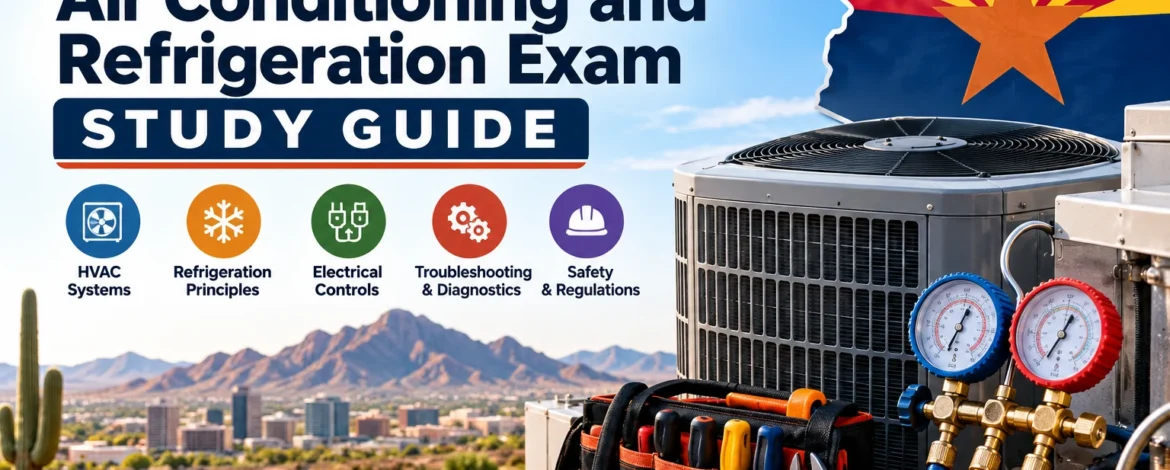
This guide breaks the subject into manageable areas, explains what to review, and provides a practical way to prepare. Use it alongside the current Arizona Registrar of Contractors requirements and the official examination information applicable to your licensing application.
1. Understand What You Need to Prepare For
Before choosing study materials, confirm the requirements for your specific Arizona CR-39 license application. Check the current licensing and examination information rather than relying on an older online checklist. Exam arrangements, reference requirements, and administrative procedures can change.
As you organize your preparation, separate licensing administration from technical knowledge. Application requirements determine what you must do to qualify, while your technical preparation develops the knowledge needed to answer trade-related questions accurately.
- Licensing and examination requirements: Verify the applicable Arizona requirements, examination instructions, and any required reference materials.
- Refrigeration principles: Review heat transfer, pressure-temperature relationships, refrigerant flow, and the refrigeration cycle.
- Air conditioning equipment: Understand the roles of compressors, condensers, evaporators, metering devices, fans, and filters.
- Electrical and control systems: Study motors, capacitors, contactors, relays, thermostats, protective devices, and control circuits.
- Installation and service: Review system commissioning, airflow, refrigerant piping, maintenance, and systematic troubleshooting.
- Safety and applicable codes: Study safe work practices, electrical isolation, refrigerant handling, and the regulations relevant to your exam references.
Do not assume that every topic carries equal weight on the examination. Use the current candidate instructions and any applicable content outline to decide how much study time each area deserves.
2. Learn the Refrigeration Cycle Before Memorizing Individual Components
The refrigeration cycle is the foundation for understanding cooling performance and diagnosing common system problems. Rather than memorizing four component names in isolation, learn what happens to the refrigerant as it moves through the system and how pressure, temperature, and heat transfer change along the way.
Evaporator: Absorbing Heat
The evaporator allows refrigerant to absorb heat from the air or another medium being cooled. As refrigerant boils inside the evaporator, it takes in heat and changes from a liquid-vapor mixture toward vapor. The system’s design and operating conditions determine how effectively this process occurs.
When reviewing evaporator operation, connect refrigerant behavior with airflow and heat transfer. Restricted airflow, a dirty coil, an incorrect refrigerant charge, or a metering problem can produce overlapping symptoms. A technician should evaluate operating conditions rather than assume that one symptom proves a particular fault.
Compressor: Moving Refrigerant and Raising Pressure
The compressor draws in low-pressure refrigerant vapor and compresses it, producing a higher-pressure, higher-temperature discharge vapor under normal operating conditions. It helps maintain refrigerant circulation through the system.
For exam preparation, understand the difference between a compressor’s intended function and the symptoms associated with a malfunction. Unusual noise, overheating, poor cooling, or abnormal pressure readings can have multiple causes. Learn how to interpret the available evidence before selecting a diagnosis.
Condenser: Rejecting Heat
The condenser releases heat from the refrigerant to the surrounding air or water, depending on the system design. As heat is removed, the refrigerant vapor condenses into liquid. In an air-cooled unit, condenser airflow and outdoor conditions can strongly influence performance.
Review the effects of dirty condenser coils, blocked airflow, fan problems, and elevated outdoor temperatures. These conditions may affect head pressure and overall cooling performance, but the correct diagnosis depends on the complete set of operating measurements.
Metering Device: Controlling Refrigerant Flow
A metering device regulates refrigerant flow into the evaporator and creates the pressure drop needed for the low-pressure side of the cycle. Common designs include thermostatic expansion valves, electronic expansion valves, and fixed-orifice devices.
Know how these devices differ and why their operation matters. A restriction, incorrect adjustment where applicable, or a control problem may affect evaporator feeding and system performance. Avoid assuming that every low-suction-pressure condition indicates low refrigerant charge.
3. Use the Refrigeration Cycle to Think Through Problems
Exam questions may describe an operating condition without directly naming the failed component. Your task is to connect the symptom to the underlying process and decide what information would help distinguish between possible causes.
| System Area | What to Understand | Study Question |
|---|---|---|
| Evaporator | Heat absorption, airflow, and refrigerant evaporation | How might restricted airflow affect coil performance? |
| Compressor | Compression, refrigerant circulation, and discharge conditions | What measurements would help evaluate a suspected compressor problem? |
| Condenser | Heat rejection and the effects of airflow | Why might poor condenser airflow affect operating pressure? |
| Metering device | Refrigerant flow and the pressure drop into the evaporator | How could a restricted metering device influence evaporator conditions? |
When answering a technical question, identify the condition being described, recall the relevant system principle, and eliminate options that do not fit the evidence. If a question involves testing or servicing energized equipment or refrigerant circuits, account for the applicable safety procedures rather than choosing a shortcut.
4. Build a Study Routine Around Understanding, Not Memorization
Reading a chapter once can make the material feel familiar without proving that you can apply it. After reviewing a topic, close your notes and explain the principle in your own words. Then answer questions without looking at the explanation until you have committed to an answer.
Keep a separate list of mistakes. Record the topic, why your answer was incorrect, and the principle that would help you solve a similar problem next time. This turns missed questions into a targeted review plan instead of a reason to reread everything.
Once you have reviewed the fundamentals, use the Arizona CR-39 practice questions and explanations to check your understanding and identify subjects that need further study. Treat practice results as feedback about your preparation, not as a guarantee of your score on the actual examination.
5. Electrical Components and HVAC Control Systems
A refrigeration system can have a perfectly sound refrigerant circuit and still fail to cool because an electrical component or control is not operating correctly. For the Arizona CR-39 exam, make sure you understand how the electrical side of an HVAC system works, not just the mechanical components.
Start with the purpose of each component. You should be able to explain what it does, what may happen when it fails, and which checks can help identify the problem.
| Component | Main Function | What to Review |
|---|---|---|
| Contactor | Switches power to equipment when its coil is energized. | Coil operation, contacts, control voltage, and safe testing. |
| Capacitor | Helps applicable motors start or run as designed. | Capacitance ratings, common failure symptoms, and safe discharge procedures. |
| Relay | Uses a control signal to operate an electrical circuit. | Switching function, contacts, and control-circuit logic. |
| Thermostat | Signals the system to operate in response to temperature settings and conditions. | Setpoints, calls for cooling, wiring, and control sequences. |
| Protective switch | Helps prevent operation under specified unsafe or abnormal conditions. | Pressure switches, overload protection, and the conditions that trigger them. |
| Motor | Drives components such as compressors, fans, and blowers. | Starting problems, overloads, nameplate data, and electrical measurements. |
Do not study these parts as an isolated vocabulary list. Consider a condenser fan that will not run. Possible causes include a failed motor, a faulty capacitor where the motor uses one, a control problem, a wiring fault, or an interruption in the power supply. The symptom alone does not establish which component has failed.
Read the Circuit Before Choosing a Diagnosis
Practice tracing a basic control sequence from the thermostat’s call for cooling through the relevant controls and switching components. Understand how a low-voltage control circuit can command equipment that operates on a separate power circuit.
Review wiring diagrams carefully. Identify line and load connections, control terminals, grounding arrangements, and the relationship between components. A question may test whether you understand the circuit’s operation rather than whether you recognize a component’s name.
Electrical testing must follow the manufacturer’s instructions and applicable safety requirements. De-energize equipment and verify the absence of voltage before work that requires it. Capacitors can retain a dangerous charge after power is disconnected, so use the appropriate procedures and equipment.
6. Airflow, Heat Transfer, and System Performance
Good refrigeration knowledge is not enough if you overlook the air moving across the coils. Airflow affects heat transfer, comfort, equipment operation, and the symptoms a technician observes during service.
For air-conditioning systems, review the relationship between the evaporator coil, blower, air filter, return-air path, supply ducts, and conditioned space. A restricted filter or dirty coil can reduce airflow. Depending on operating conditions and equipment design, this may contribute to coil icing, reduced capacity, or abnormal operating measurements.
Important Airflow Concepts
- Air filters: Understand how loading and restriction affect airflow and why filters must match the equipment’s requirements.
- Blowers and fans: Review motor operation, fan condition, rotation where applicable, and the effect of a malfunctioning fan on heat transfer.
- Coil cleanliness: Know why dirt on evaporator and condenser surfaces can interfere with heat exchange.
- Ductwork: Study the effects of leakage, restriction, poor sizing, and inadequate return-air pathways.
- Temperature measurements: Understand how to take and interpret temperature readings in context rather than relying on a single number.
Be particularly careful with questions about a frozen evaporator coil. Low airflow is one possible cause, but refrigerant-feed problems and other operating conditions may also contribute. A sound troubleshooting process checks the evidence before deciding on the cause.
7. Superheat, Subcooling, and Refrigerant Measurements
Superheat and subcooling are important concepts in refrigeration service. They help technicians evaluate refrigerant conditions and system performance when measured and interpreted using the correct procedure.
Superheat
Superheat is the difference between the actual refrigerant vapor temperature and the saturation temperature at the corresponding pressure. In practical terms, it tells you how much warmer the vapor is than its saturation temperature at that pressure.
The basic calculation is:
Superheat = Actual vapor temperature − Saturation temperature
For example, suppose the measured suction-line temperature is 55°F and the saturation temperature corresponding to the measured suction pressure is 40°F.
Superheat = 55°F − 40°F = 15°F
The result is 15°F of superheat. The important exam skill is understanding the calculation and using the correct pressure-temperature relationship for the refrigerant involved.
Subcooling
Subcooling is the difference between the saturation temperature corresponding to the measured liquid-side pressure and the actual liquid refrigerant temperature.
Subcooling = Saturation temperature − Actual liquid temperature
For example, if the calculated saturation temperature is 100°F and the measured liquid-line temperature is 90°F:
Subcooling = 100°F − 90°F = 10°F
This gives 10°F of subcooling. Do not confuse the order of subtraction with the superheat calculation: superheat compares vapor temperature against saturation temperature, while subcooling compares saturation temperature against liquid temperature.
What Candidates Should Understand
- How to obtain saturation temperature from the correct refrigerant pressure-temperature data.
- Why the refrigerant type and measurement location matter.
- How superheat and subcooling differ and what each measurement describes.
- Why measurements should be interpreted alongside airflow, load, ambient conditions, metering-device type, and manufacturer specifications.
- Why one reading by itself is not enough to confirm refrigerant charge or diagnose every system fault.
When practicing calculations, write down the formula before inserting the values. This simple habit helps prevent subtraction errors and makes it easier to spot an answer that does not fit the information in the question.
8. Installation, Maintenance, and Troubleshooting Principles
Exam preparation should also cover what happens before a system begins normal operation and what a technician should inspect when performance deteriorates. A system may contain functional components yet still perform poorly because of installation errors, inadequate maintenance, or incorrect setup.
Review these areas using the applicable manufacturer instructions, technical references, and current requirements relevant to your examination.
- Refrigerant piping: Understand correct piping practices, support, protection, and the importance of keeping the system clean and dry.
- Leak testing: Review approved procedures, appropriate test equipment, and the safety precautions required for the refrigerant and system involved.
- Evacuation: Understand why moisture and non-condensable gases must be controlled and why evacuation procedures should follow applicable technical requirements.
- Commissioning: Review startup checks, operating measurements, control operation, and verification against manufacturer specifications.
- Preventive maintenance: Understand the value of inspecting coils, filters, electrical connections, fans, drains, and other serviceable components.
- Documentation: Recognize why recording measurements, identified faults, and completed work supports accurate service and follow-up.
Follow a Consistent Troubleshooting Sequence
When a system is not cooling properly, resist the urge to jump immediately to a refrigerant-related diagnosis. A consistent sequence helps you separate a control problem from an airflow issue, an electrical failure, or a refrigeration fault.
- Confirm the complaint: Establish what the equipment is doing and under what operating conditions.
- Check basic conditions: Review thermostat settings, filters, airflow, visible damage, and obvious restrictions.
- Verify the control sequence: Determine whether the system is receiving the appropriate call for operation and whether required controls are responding.
- Inspect electrical operation safely: Use suitable procedures and measurements to evaluate power, controls, and components.
- Measure system performance: Take the relevant temperature, pressure, and airflow measurements and compare them with appropriate reference values.
- Test the suspected cause: Confirm the diagnosis with evidence before recommending a repair.
For study purposes, practice explaining why each step comes before the next. This develops the reasoning needed for scenario-based questions, where several answer choices may sound plausible but only one is supported by the information provided.
After reviewing these technical areas, work through the CR-39 exam practice set with answer explanations to identify which subjects still need attention. When you miss a question, revisit the underlying principle and try a similar problem rather than memorizing the correct letter.
9. How to Study for the Arizona CR-39 Exam Efficiently
Studying after a full day of HVAC work can be difficult, especially when you already understand many of the concepts from hands-on experience. The challenge is identifying gaps in your knowledge and becoming comfortable applying technical principles to questions you have not seen before.
Instead of spending every session reading a manual from beginning to end, divide your preparation into three activities: review a specific topic, answer questions about it, and analyze the mistakes. This makes each study session purposeful and helps you decide what deserves more attention.
Use a Three-Step Review Method
- Review one subject: Choose a focused area such as electrical controls, the refrigeration cycle, airflow, or troubleshooting. Review your approved references and write down the important principles.
- Answer questions without notes: Attempt practice questions before checking the explanations. This shows whether you can recall and apply the information independently.
- Correct the reasoning: For every incorrect answer, identify what you misunderstood, what information you overlooked, and which principle supports the correct answer.
Keep an error log rather than simply recording your score. For example, if you repeatedly confuse superheat and subcooling, write both definitions and solve a few calculations. If you miss questions about contactors or capacitors, review their functions and the diagnostic steps used to evaluate them.
10. A Four-Week Arizona CR-39 Study Schedule
A four-week plan can provide structure for candidates who already have some HVAC or refrigeration knowledge. If the technical material is unfamiliar, extend the schedule instead of rushing through topics you cannot yet explain confidently.
| Week | Main Focus | Study Tasks |
|---|---|---|
| Week 1 | Refrigeration fundamentals | Review the refrigeration cycle, component functions, heat transfer, pressure-temperature relationships, superheat, and subcooling. |
| Week 2 | Electrical and control systems | Study motors, contactors, capacitors, relays, thermostats, wiring diagrams, and protective devices. |
| Week 3 | Installation and diagnosis | Review airflow, installation practices, commissioning, maintenance, safety, and troubleshooting scenarios. |
| Week 4 | Practice and targeted revision | Complete mixed practice sets, review incorrect answers, revisit weak areas, and confirm exam-day requirements. |
Try to study for 30–60 minutes on days when your schedule allows, with a longer session at the weekend if needed. Consistency matters more than completing a large number of questions in one sitting and forgetting the explanations afterward.
11. Original Arizona CR-39 Practice Questions
Use the following questions to check your understanding of basic HVAC and refrigeration principles. They are original study examples, not actual or previously administered Arizona licensing exam questions.
Question 1: Calculating Superheat
A technician measures a suction-line temperature of 58°F. The corresponding refrigerant saturation temperature is 42°F. What is the superheat?
- A. 12°F
- B. 16°F
- C. 42°F
- D. 100°F
Correct Answer: B. 16°F
Explanation: Superheat is calculated by subtracting the saturation temperature from the actual vapor temperature. In this example, 58°F − 42°F = 16°F. The answer is the temperature difference, not either of the original readings.
Why the Other Options Are Incorrect:
- A. 12°F: This does not result from subtracting the given temperatures.
- C. 42°F: This is the saturation temperature provided in the question.
- D. 100°F: This is not the difference between the two measurements.
Quick Study Guide: Superheat = actual vapor temperature − saturation temperature. Always use the correct refrigerant pressure-temperature data to determine saturation temperature.
Question 2: Restricted Condenser Airflow
An air-cooled air-conditioning system has a heavily obstructed condenser coil. Which operating problem may result?
- A. Improved heat rejection under all conditions
- B. Elevated condensing pressure and reduced system performance
- C. Elimination of compressor work
- D. Guaranteed reduction in electrical current
Correct Answer: B. Elevated condensing pressure and reduced system performance
Explanation: The condenser must transfer heat from the refrigerant to the surrounding air. When airflow is restricted, heat rejection can deteriorate and condensing pressure may rise. The exact operating response depends on equipment design and conditions, so technicians should verify the problem through appropriate inspection and measurements.
Why the Other Options Are Incorrect:
- A. Improved heat rejection under all conditions: Obstructed airflow generally interferes with the condenser’s ability to reject heat.
- C. Elimination of compressor work: The compressor remains necessary for refrigerant circulation and compression.
- D. Guaranteed reduction in electrical current: Current cannot be predicted from this symptom alone and may increase under some operating conditions.
Quick Study Guide: Review condenser cleanliness, fan operation, outdoor conditions, and airflow. Never diagnose a refrigerant problem from one symptom alone.
Question 3: Electrical Troubleshooting
A condenser fan does not start when cooling is requested. What is the best initial approach?
- A. Add refrigerant immediately
- B. Replace the compressor without testing
- C. Follow the appropriate safety procedure and systematically check the power supply, controls, and fan circuit
- D. Bypass all protective devices and leave the system running
Correct Answer: C. Follow the appropriate safety procedure and systematically check the power supply, controls, and fan circuit
Explanation: A fan that does not run may have an electrical supply problem, a control fault, a failed motor, a defective capacitor where applicable, or another component issue. Systematic diagnosis helps distinguish these possibilities before a repair is selected.
Why the Other Options Are Incorrect:
- A. Add refrigerant immediately: The symptom alone does not establish that the system is undercharged.
- B. Replace the compressor without testing: A non-operating fan does not prove that the compressor has failed.
- D. Bypass all protective devices and leave the system running: This is unsafe and may damage equipment or expose people to hazards.
Quick Study Guide: Identify the symptom, follow safe diagnostic procedures, check the relevant circuit, and confirm the cause before repairing the equipment.
12. Common Preparation Mistakes That Can Hold You Back
Some candidates spend plenty of time studying but make little progress because their preparation does not reveal what they actually understand. Watch for these habits as you work through the material.
- Memorizing answers instead of principles: Learn why an answer is correct so you can handle a question that describes the same concept differently.
- Ignoring calculations: Practice formulas and units regularly. Familiarity with the concept does not automatically prevent arithmetic errors.
- Guessing from a single symptom: Learn to distinguish possible causes and identify what evidence would support a diagnosis.
- Skipping electrical fundamentals: Practical refrigeration knowledge does not replace an understanding of controls, motors, wiring, and protective devices.
- Using outdated references without checking: Confirm the current examination instructions and the edition or reference requirements that apply to your test.
- Leaving review until the final day: Revisit difficult topics throughout your preparation rather than relying on one last-minute session.
13. How to Tell When You Are Ready
A high practice score is encouraging, but readiness involves more than recognizing familiar questions. You should be able to explain technical principles, complete calculations accurately, and identify why alternative answers do not fit the situation described.
Before scheduling or sitting for your examination, use this checklist to evaluate your preparation.
- Can I explain the purpose of the evaporator, compressor, condenser, and metering device?
- Can I calculate superheat and subcooling from appropriate measurements?
- Can I interpret basic HVAC wiring diagrams and explain the function of common electrical components?
- Can I distinguish an airflow problem from a potential electrical or refrigerant-circuit fault?
- Can I explain safe diagnostic and maintenance procedures?
- Can I answer mixed practice questions without relying on notes?
- Do I understand why my incorrect answers were wrong?
- Have I confirmed the current examination arrangements, permitted references, and applicable licensing instructions?
If several answers are no, use those gaps to set your next study priorities. There is no benefit in repeatedly reviewing material you already understand while leaving difficult topics untouched.
14. Continue Preparing With Focused Practice
Once you have reviewed the fundamentals, move into mixed practice sessions that require you to switch between refrigeration principles, electrical controls, calculations, and troubleshooting. This is more useful than answering questions from only one familiar subject every time you study.
The Arizona CR-39 contractor exam practice resource can help you check your knowledge, work through explanations, and identify areas for additional review. Use it alongside the current official examination information and the technical references applicable to your licensing path.
For each practice session, record your weakest topics and revisit them before taking another mixed set. As your understanding becomes more consistent, focus on accuracy, careful reading, and explaining your reasoning rather than simply trying to finish more questions.
The strongest preparation combines technical understanding, deliberate practice, safe troubleshooting principles, and a clear plan for reviewing mistakes. Build those habits steadily, and you will have a much clearer picture of where you stand before exam day.