Sale!

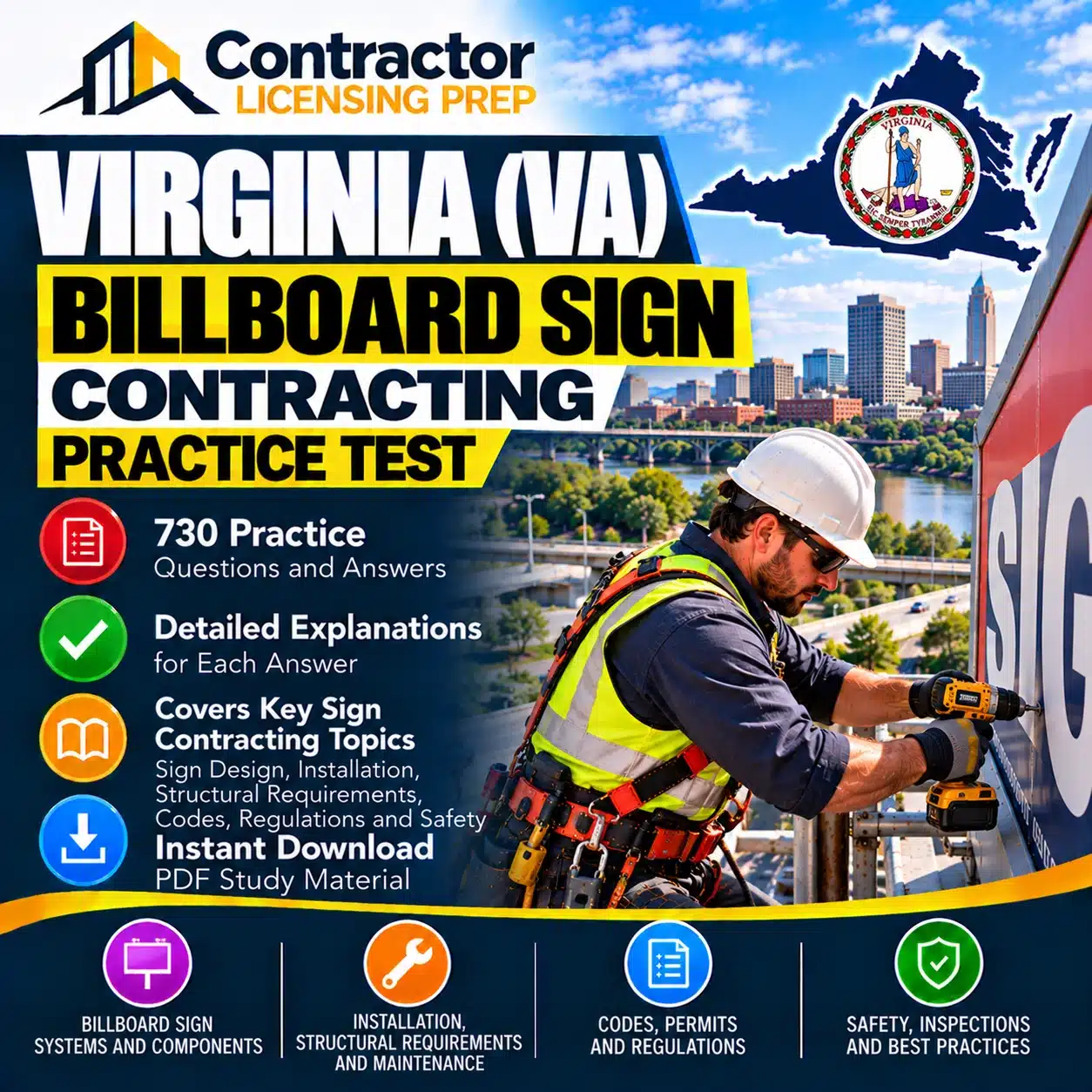
VA Billboard Sign Contracting (BSC) Certification Practice Test

✓ 730 Question with Explained Answers (Instant PDF Download)

Original price was: $59.95.Current price is: $39.99.

Ready to Get Full Access?

Get the complete practice test with detailed answer explanations and prepare at your own pace.

Original price was: $59.95.Current price is: $39.99.

VA Billboard Sign Contracting (BSC) Certification Practice Test helps candidates prepare for Virginia’s Billboard/Sign Contracting specialty examination with focused practice questions, detailed answer explanations, and practical construction scenarios. Working with billboard structures requires more than knowing how signs are assembled. Contractors must understand sign materials, structural supports, concrete foundations, steel erection, rigging procedures, and jobsite safety requirements to complete installations safely and correctly.

Whether you are preparing for the Virginia DPOR specialty examination or strengthening your knowledge of billboard installation and structural sign work, this practice test offers a structured way to review essential technical concepts. Work through exam-style questions, evaluate practical construction situations, and use the explanations to identify areas that deserve additional study.

Start preparing today with targeted BSC certification practice questions. Strengthen your understanding of sign construction, structural installation, and safety procedures before your Virginia specialty examination.

Prepare for the Virginia Billboard Sign Contracting Exam

The Virginia Billboard/Sign Contracting (BSC) classification covers the installation, repair, improvement, and dismantling of billboards and structural signs permanently attached to real property.

This work requires knowledge of the materials used in sign construction, the methods used to erect and secure structures, and the safety precautions necessary when working with heavy components, elevated platforms, cranes, and electrical equipment.

The Virginia BSC practice test helps you review the technical subjects associated with billboard and structural sign contracting.

Important study areas include:

  • Billboard and structural sign materials
  • Steel components, fasteners, and structural connections
  • Concrete foundations and reinforcement
  • Foundation preparation, excavation, and formwork
  • Steel erection and structural stability
  • Welding principles and connection requirements
  • Rigging equipment, lifting procedures, and load handling
  • Crane operations and suspended loads
  • OSHA construction safety requirements
  • Fall protection and elevated work platforms
  • Excavation hazards and underground utility considerations
  • Installation, repair, and dismantling procedures

Reviewing these topics helps you understand the relationship between material selection, structural stability, installation methods, and worker safety.

What Makes This BSC Practice Test Useful?

Billboard construction involves several interconnected technical decisions. A foundation must support the intended structure, connections must transfer loads appropriately, and lifting operations must account for the weight and movement of structural components.

Practice questions help you evaluate your ability to apply these principles to realistic jobsite situations.

Strengthen material knowledge: Review the characteristics and applications of structural steel, concrete, reinforcement, fasteners, and other sign components.

Understand foundation requirements: Practice evaluating excavation, reinforcement, formwork, concrete placement, and foundation preparation.

Improve structural reasoning: Review connections, steel erection procedures, bracing, and stability during installation.

Recognize rigging hazards: Understand load handling, lifting equipment, rigging components, and precautions for suspended materials.

Reinforce safety awareness: Review fall protection, crane operations, excavation hazards, and applicable OSHA requirements.

Learn from answer explanations: Understand why a particular construction method is appropriate and why alternative choices may create structural or safety problems.

This approach helps you prepare for technical questions that require practical judgment rather than simple memorization.

What Is the Virginia BSC Certification Examination?

The Virginia Billboard/Sign Contracting examination is a specialty examination administered through the contractor examination program associated with the Virginia Department of Professional and Occupational Regulation (DPOR).

The published PSI examination outline identifies three principal subject areas: Billboard/Sign Materials, Billboard/Sign Erection, and Safety. The examination evaluates knowledge needed to perform specialty contracting work competently and responsibly.

Candidates should review the current official candidate information bulletin for the applicable examination format, reference materials, testing procedures, and passing requirements. Reference editions and examination policies should be verified before scheduling.

The specialty examination is separate from any other contractor licensing requirements that may apply to an individual’s business or license classification.

This practice test is an independent study resource and is not an official DPOR or PSI examination.

Review the Core Topics for the Virginia BSC Exam

Billboard and Sign Materials

Material selection affects a sign structure’s durability, strength, and resistance to environmental exposure. Study structural steel, aluminum, concrete, reinforcement, bolts, anchors, and other commonly used construction materials.

Understand how corrosion, weather exposure, connection details, and material condition can affect long-term performance. Practice identifying suitable materials and recognizing defects that may compromise a sign installation.

Foundations and Concrete Construction

Billboard foundations transfer structural loads into the supporting soil. Candidates should understand excavation, soil conditions, formwork, reinforcement placement, concrete installation, and anchor-bolt positioning.

Questions may involve identifying a foundation preparation problem, recognizing incorrect reinforcement placement, or understanding why foundation dimensions must follow approved structural requirements.

Do not rely on generic footing dimensions or reinforcement assumptions. Actual requirements depend on the approved design, site conditions, and applicable codes.

Steel Erection and Structural Connections

Steel erection requires attention to component alignment, temporary stability, bracing, bolted connections, welding, and the correct installation sequence.

Review how loads move through the structural frame and into its supporting foundation. Understand why temporary bracing and proper connection installation are important before a structure is fully secured.

Practice recognizing conditions that require work to stop until the installation can be evaluated by the responsible qualified professional.

Rigging and Lifting Operations

Billboard panels, poles, and structural assemblies may require cranes or other lifting equipment. Review load weight, center of gravity, rigging selection, sling condition, lifting points, and communication between the operator and the lifting crew.

Understand the importance of inspecting rigging equipment, following the lift plan, and keeping workers clear of suspended loads. A lift should not proceed when equipment capacity, load stability, or site conditions have not been adequately assessed.

OSHA Safety and Jobsite Hazards

Safety is a core part of billboard contracting. Study fall protection, ladder and aerial-lift safety, crane operations, excavation hazards, personal protective equipment, and safe handling of construction materials.

Understand how workers should respond to damaged equipment, unstable work platforms, unsafe lifting conditions, or unexpected underground utility conflicts. Applicable OSHA construction standards and the site’s safety procedures should guide the work.

Installation, Repair, and Dismantling

Structural sign work may involve new construction, replacement of components, maintenance, or removal of existing structures. Each activity requires planning appropriate to the structure, equipment, and site conditions.

Review safe work sequencing, temporary support, access restrictions, equipment selection, and the need to control falling materials. Dismantling must account for the structure’s stability as components are removed.

Who Should Use This Billboard Sign Contracting Practice Test?

This practice test is suitable for:

  • Candidates preparing for the Virginia BSC specialty examination
  • Billboard installation and maintenance contractors
  • Structural sign installers and erectors
  • Construction professionals working with steel and concrete sign structures
  • Workers reviewing rigging, lifting, and fall-protection requirements
  • Candidates who want additional practice with construction safety scenarios

It can also help experienced professionals refresh their knowledge of sign materials, foundation work, structural connections, and installation safety.

Candidates should confirm the qualifications and licensing requirements applicable to their individual circumstances before applying for the examination.

How to Study for the Virginia BSC Exam

Start by reviewing the official examination outline and dividing your study time among materials, erection, and safety. Pay particular attention to subjects in which you have limited field experience.

Work through practice questions before checking the answers. When you miss a question, review the relevant technical principle and consult the applicable reference material instead of memorizing the correct option.

For structural questions, consider how loads are transferred and how the foundation, connections, and supporting frame work together. For rigging questions, evaluate load stability, equipment capacity, and the safety of workers in the lifting area.

Because the examination may be open book under the applicable testing rules, become familiar with the permitted references and practice locating information efficiently. Verify the current approved reference list and book editions before examination day.

Finally, revisit difficult subjects regularly and use mixed-topic practice sessions to evaluate your overall readiness.

Get Ready for Your Virginia BSC Certification Exam

Preparing for the Virginia Billboard/Sign Contracting examination requires an understanding of construction materials, foundation work, structural erection, rigging, and safety. Consistent practice can help you identify knowledge gaps and improve your ability to evaluate technical problems before test day.

The VA Billboard Sign Contracting (BSC) Certification Practice Test provides a focused way to review essential subject areas, apply construction principles to practical scenarios, and reinforce your knowledge through detailed answer explanations.

Begin your preparation today. Practice billboard construction scenarios, strengthen your understanding of structural installation and jobsite safety, and take a more focused approach to your Virginia BSC certification examination.

Description

Sample Questions

Question 1. A contractor is preparing to erect a large steel billboard support structure. Before lifting the main column into position, the crew discovers that several anchor bolts in the concrete foundation do not align with the base plate holes. What is the most appropriate action?

A. Enlarge the anchor bolt holes on-site without consulting the approved structural details.
B. Bend the anchor bolts until they align with the base plate.
C. Force the column into position and tighten the nuts to draw the assembly into alignment.
D. Stop the installation and have the discrepancy evaluated by the responsible qualified design professional before proceeding with an approved correction.

Correct Answer: D. Stop the installation and have the discrepancy evaluated by the responsible qualified design professional before proceeding with an approved correction.

Answer Explanation:
Option D is correct because anchor bolts transfer loads from the billboard support structure into the concrete foundation. Misalignment may affect the base plate connection, bolt engagement, load distribution, and structural stability. Improvised field modifications can reduce connection strength or violate the approved design. The contractor should stop the affected installation, document the discrepancy, and obtain an approved corrective solution from the responsible qualified design professional. Depending on the design, the solution may involve an engineered modification or an approved repair. The crew should not force the structure into position or alter structural components without authorization. Correcting the problem before erection continues helps protect workers and ensures the completed connection meets the approved requirements.

Why the other options are incorrect:
Option A modifies a structural connection without confirming that the proposed change is acceptable.
Option B may damage the anchor bolts or alter their intended structural performance.
Option C introduces forced alignment that may damage components and create unintended stresses.

Quick Study Guide:
Anchor bolts transfer structural loads into the foundation.
Base plate alignment must match the approved structural details.
Do not make unapproved modifications to structural connections.
Resolve installation discrepancies before proceeding with erection.

Question 2. A crew is preparing to lift a billboard panel using a mobile crane. The panel’s weight is known, but the lifting supervisor cannot verify the center of gravity or the suitability of the proposed rigging attachment points. What should happen before the lift begins?

A. Proceed slowly and allow the crane operator to correct any panel movement during the lift.
B. Confirm the load characteristics, approved lifting points, rigging configuration, and crane capacity before authorizing the lift.
C. Attach additional slings wherever convenient to prevent the panel from swinging.
D. Increase the crane’s boom angle without reviewing the manufacturer’s load chart.

Correct Answer: B. Confirm the load characteristics, approved lifting points, rigging configuration, and crane capacity before authorizing the lift.

Answer Explanation:
Option B is correct because a safe lift requires an adequate understanding of the load’s weight, center of gravity, lifting points, rigging arrangement, and crane capacity under the actual operating configuration. An incorrectly balanced billboard panel can rotate unexpectedly, overload individual rigging components, or place workers at risk. The lifting supervisor should ensure that the lift plan and rigging arrangement are appropriate and that the crane’s capacity is sufficient for the operating radius, boom configuration, and other applicable conditions. Required inspections and communication procedures must also be followed. If essential load information cannot be verified, the lift should not proceed until the uncertainty has been resolved.

Why the other options are incorrect:
Option A allows an uncontrolled load movement to develop instead of addressing the hazard before lifting.
Option C adds rigging without confirming attachment strength, sling angles, or load distribution.
Option D changes the crane configuration without checking the applicable load chart and operating limits.

Quick Study Guide:
Verify load weight and center of gravity before lifting.
Use suitable, inspected rigging and approved attachment points.
Confirm crane capacity for the actual operating configuration.
Do not begin a lift while critical load information remains uncertain.

Question 3. During construction of a billboard foundation, the excavation crew encounters an underground utility line that was not identified in the available site information. The line’s location and service status are unknown. What is the safest next step?

A. Continue excavation carefully with smaller equipment until the line is fully exposed.
B. Move the excavation a short distance and resume work without notifying anyone.
C. Stop the affected excavation, protect the area, and arrange for the utility to be identified and addressed through the appropriate procedures.
D. Cut through the line if it appears to be abandoned and no fluid is visible.

Correct Answer: C. Stop the affected excavation, protect the area, and arrange for the utility to be identified and addressed through the appropriate procedures.

Answer Explanation:
Option C is correct because an unidentified underground utility may carry electricity, gas, water, communications, or other services. Disturbing the line could cause electrocution, fire, an explosion, flooding, service disruption, or serious injury. The crew should stop work in the affected area, protect workers from exposure, and follow the applicable excavation and utility-location procedures. The responsible utility owner or qualified personnel should identify the line and determine the appropriate safeguards before excavation resumes. The contractor must also comply with applicable OSHA requirements and state or local utility-locating rules. A line should never be assumed to be inactive simply because its appearance or condition suggests that it may be abandoned.

Why the other options are incorrect:
Option A continues potentially hazardous work before the utility has been identified.
Option B does not establish whether the utility remains within the new excavation area or whether the hazard has been controlled.
Option D risks damaging an active utility and creating a serious incident.

Quick Study Guide:
Unknown underground utilities must be treated as potentially hazardous.
Stop affected excavation until the line is identified and appropriate precautions are established.
Follow utility-location procedures and applicable excavation safety requirements.
Never assume a utility is inactive based on appearance alone.

Question 4. A billboard structure is being erected beside a roadway. During installation, the crew notices that temporary bracing has loosened before the permanent structural connections are fully secured. Wind is increasing, and the partially erected frame begins to sway. What should the supervisor do?

A. Stop the affected work, keep personnel clear of the danger area, and have the structure stabilized under an appropriate safe-work procedure before continuing.
B. Ask workers to hold the frame manually while the remaining bolts are installed.
C. Remove the remaining temporary bracing so the structure can move freely with the wind.
D. Continue tightening the permanent connections while workers remain beneath the frame.

Correct Answer: A. Stop the affected work, keep personnel clear of the danger area, and have the structure stabilized under an appropriate safe-work procedure before continuing.

Answer Explanation:
Option A is correct because temporary bracing provides stability while a structure is being erected and before its permanent connections can safely resist the required loads. Loosened bracing, increasing wind, and visible frame movement indicate that the structure may be unstable. Continuing work beneath or beside the frame could expose workers to collapse or falling-component hazards. The supervisor should stop the affected operation, establish an exclusion area, and arrange for stabilization using an appropriate procedure developed by qualified personnel. Work should resume only after the structure’s stability has been verified and conditions are suitable. Erection sequencing and temporary support are essential considerations in steel construction, particularly when large sign assemblies are exposed to wind.

Why the other options are incorrect:
Option B exposes workers to dangerous forces that cannot be safely controlled by manually holding the structure.
Option C removes support from a frame that is already showing signs of instability.
Option D places workers beneath a potentially unstable structure and prioritizes bolt installation over immediate safety.

Quick Study Guide:
Temporary bracing maintains stability during structural erection.
Wind and loose connections can increase the risk of instability.
Keep workers clear of structures that may collapse or shift.
Verify stability before resuming erection activities.

Question 5. During a final inspection of a newly installed billboard, a contractor finds corrosion around several steel connection plates and loose fasteners at a structural joint. The billboard remains standing, and no obvious deformation is visible. What is the most appropriate response?

A. Apply paint over the corrosion and leave the fasteners unchanged.
B. Tighten the fasteners using any available tool and accept the structure if it looks stable afterward.
C. Ignore the condition because the absence of visible deformation confirms that the structure is safe.
D. Document the deficiencies and obtain an appropriate structural evaluation and corrective action before accepting the affected work.

Correct Answer: D. Document the deficiencies and obtain an appropriate structural evaluation and corrective action before accepting the affected work.

Answer Explanation:
Option D is correct because corrosion and loose fasteners can compromise the integrity of a structural connection, even when the billboard appears stable. Corrosion may reduce the effective thickness of steel components, while loose fasteners may affect the connection’s ability to transfer the loads specified by the design. The contractor should document the condition and arrange for evaluation by the responsible qualified professional to determine the extent of deterioration and the required corrective work. Repairs may involve cleaning, component replacement, approved fastener installation, or other engineered measures, depending on the findings. Applying paint or tightening fasteners without evaluation may conceal the problem or introduce additional damage. Structural acceptance should be based on verified compliance, not appearance alone.

Why the other options are incorrect:
Option A conceals visible corrosion without establishing whether the affected steel or connection remains adequate.
Option B uses an unspecified tightening method and does not determine whether the fasteners or connection components require repair.
Option C assumes that visible stability proves the connection can safely resist the required loads.

Quick Study Guide:
Corrosion can reduce the capacity of structural steel components.
Loose fasteners may affect a connection’s load-transfer performance.
Document deficiencies and obtain the appropriate technical evaluation.
Accept structural work only after required corrective actions are verified.

Ready to Download the Complete Practice Test?

Get the complete downloadable practice test with answer explanations and continue preparing at your own pace.
Original price was: $59.95.Current price is: $39.99.

Reviews

There are no reviews yet.

Be the first to review “VA Billboard Sign Contracting (BSC) Certification Practice Test”

Your email address will not be published. Required fields are marked *

FAQs

Which agency oversees contractor licensing for billboard sign contracting in Virginia?

The Virginia Department of Professional and Occupational Regulation (DPOR) oversees contractor licensing through the Board for Contractors. Candidates should confirm the applicable specialty classification and licensing requirements before applying.

Is the Virginia BSC specialty examination separate from the general contractor licensing examination?

Yes. The BSC specialty examination assesses knowledge related to billboard and sign contracting. Depending on the license sought and the applicant's circumstances, additional contractor licensing examinations or requirements may also apply.

What reference materials should candidates review for the Virginia BSC examination?

Candidates should consult the current PSI candidate information bulletin for the approved reference materials and applicable editions. The examination outline identifies the principal subject areas, but the current bulletin should be used to confirm which books are permitted during testing.

Does passing the BSC examination automatically grant a Virginia contractor license?

No. Passing the specialty examination does not automatically complete the licensing process. Applicants must satisfy the applicable Board for Contractors requirements, which may include business qualifications, financial requirements, and other licensing conditions.

Can a contractor perform billboard installation and dismantling work under the BSC classification?

The Billboard/Sign Contracting classification covers qualifying work involving the installation, repair, improvement, and dismantling of billboards and structural signs permanently attached to real property. Contractors must remain within their authorized classification and meet any other applicable permit, building-code, and safety requirements.