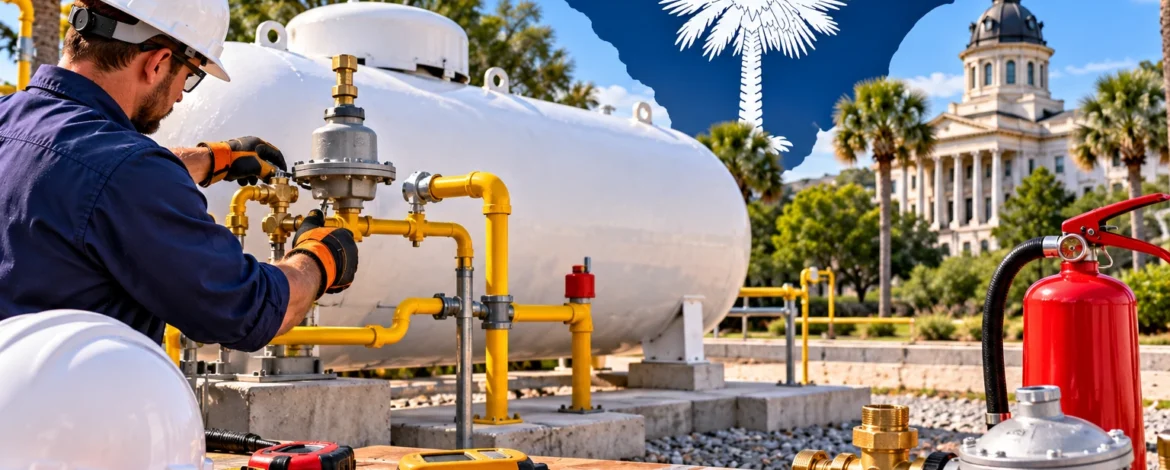
A safe installation depends on more than choosing the right tank or connecting a fuel line. Container location, piping materials, pressure controls, protection against physical damage, and emergency procedures all play a role. Understanding how these elements work together helps contractors recognize potential problems before equipment is placed into service.
This guide explains essential LP-Gas safety principles, how to approach common installation concerns, and where to verify the requirements that apply in South Carolina. It is intended as an educational reference, not a substitute for the adopted code, manufacturer instructions, or a site-specific inspection.
How South Carolina Regulates LP-Gas Safety
The South Carolina Liquefied Petroleum Gas Board operates through the Department of Labor, Licensing and Regulation (LLR). Its responsibilities include establishing and enforcing minimum standards for the design, construction, location, installation, and operation of equipment used to store, handle, transport, and use LP-Gas.
South Carolina’s regulatory framework includes several sources that serve different purposes:
| Authority or reference | Why it matters |
|---|---|
| NFPA 58, Liquefied Petroleum Gas Code | Addresses LP-Gas storage, handling, transportation, equipment, and system installation within its scope. |
| South Carolina Code of Laws, Title 40, Chapter 82 | Establishes the state’s statutory framework for LP-Gas licensing and regulation. |
| South Carolina Regulation 71-8304 and related provisions | Provides state administrative requirements for LP-Gas activities. |
| Applicable fuel-gas codes | Address relevant fuel-gas piping and appliance installation requirements within their scope. |
| Manufacturer instructions and applicable local requirements | Help determine equipment-specific installation conditions and additional permitting or inspection obligations. |
These sources are not interchangeable. A national standard does not automatically answer every question about state licensing, and a manufacturer’s instruction does not replace a governing code requirement. The correct approach is to identify the applicable authority and verify the requirement for the specific installation.
Start with the official South Carolina LP-Gas laws and regulations and the Board’s plan review and inspection guidance. Check the applicable editions and current state requirements before relying on a technical provision.
Why Propane Requires Specific Safety Controls
Propane is stored as a liquid under pressure and becomes a gas when released under normal atmospheric conditions. A leak can therefore create a flammable vapor cloud, while liquid propane escaping from a pressurized system can cause severe cold-contact injuries. Ignition of accumulated propane can lead to a flash fire or explosion.
Several physical properties explain why installation and operating procedures matter:
- Flammability: Propane can ignite when it mixes with air in the flammable range and encounters an ignition source.
- Vapor behavior: Propane vapor is heavier than air under comparable conditions and may collect in low areas where ventilation is poor.
- Pressure: Propane pressure changes with temperature. Containers, piping, regulators, valves, and other components must be suitable for their intended service.
- Liquid expansion: Liquid propane expands as it warms. Containers must not be filled beyond the limits established by the applicable requirements and equipment design.
- Cold-contact hazards: Rapid vaporization of liquid propane can cause frostbite-like injuries to exposed skin.
These properties influence the controls used in storage, transfer, piping design, pressure regulation, and emergency response. For example, a low-lying area near a leaking connection may present a serious hazard even when the release is not immediately visible.
Container Placement: Evaluate the Entire Installation
Choosing a location for a propane container requires more than measuring the distance to the nearest wall. The applicable separation requirements can depend on the container’s capacity, construction, orientation, installation type, and the nearby features identified in the governing code.
Before approving a proposed location, review the following considerations:
| Consideration | What to verify |
|---|---|
| Container type and capacity | Identify the container specifications and the code provisions that apply to that configuration. |
| Nearby buildings and openings | Check the applicable separation rules for buildings, doors, windows, and other relevant features. |
| Property lines and adjoining areas | Determine which property boundaries and neighboring features must be considered. |
| Vehicle traffic | Evaluate the need for protection against vehicle impact and other foreseeable physical damage. |
| Container support and surroundings | Verify suitable support, stability, drainage, access, and applicable installation requirements. |
| Emergency access | Check access to required valves, controls, and other safety equipment. |
Practical example: A contractor proposes placing a propane container beside a commercial building. The location appears convenient, but a vehicle routinely backs into the same area, and a building opening is nearby. The contractor should not approve the site based on convenience alone. The proposed layout must be evaluated against the applicable separation rules, vehicle-impact protection requirements, and other relevant provisions.
South Carolina LLR publishes separate installation guidelines for reseller sites and bulk facilities. These documents can help identify items to review during planning, but the Board explicitly states that the guidelines do not replace applicable codes or state and local laws. Use the official installation and site plan resources when evaluating a proposed project.
For candidates reviewing the broader licensing and examination context, the South Carolina LP-Gas Dealer/Installer exam study guide provides a complementary resource focused on exam preparation and code-book study techniques.
Recognizing Problems Before an Installation Is Approved
A useful safety review looks for conditions that require verification rather than assuming that a new installation is compliant because its components are new.
- Container placement has not been checked against the applicable separation requirements.
- Piping or fittings may be unsuitable for the service or operating conditions.
- Equipment is exposed to foreseeable vehicle impact or other physical damage.
- Required valves, controls, or safety devices are inaccessible or incorrectly located.
- Installation documentation, required permits, or inspection arrangements are incomplete.
Finding a concern does not automatically establish a code violation. It identifies a condition that must be evaluated against the applicable requirement. When a provision is unclear, consult the governing code, the authority having jurisdiction, or a qualified professional rather than guessing.
LP-Gas Piping: Materials, Connections, and Installation Safety
LP-Gas piping provides the path that carries fuel from its source to the equipment that uses it. A system can contain a properly installed container and still present a serious hazard if the piping, fittings, supports, or connections are unsuitable for the intended service.
When evaluating a piping installation, consider the entire system rather than looking at individual components in isolation. The appropriate requirements depend on the system design, pressure, materials, location, equipment specifications, and applicable code.
| Inspection area | What deserves attention | Why it matters |
|---|---|---|
| Pipe and tubing materials | Confirm that the material and product are permitted for the intended application. | Not every piping product is suitable for LP-Gas service or every installation location. |
| Fittings and joints | Check compatibility, approved connection methods, and installation quality. | Improper connections can create leakage paths or mechanical weaknesses. |
| Supports and protection | Review support, exposure, corrosion risks, and protection against physical damage. | Movement, impact, and deterioration can compromise the system. |
| Pressure suitability | Verify that piping and components are rated for their intended operating conditions. | A component that is unsuitable for the system pressure may fail or operate improperly. |
| Testing and inspection | Follow the required procedures and acceptance criteria for the specific system. | Appropriate verification helps identify defects before the system is placed into service. |
For example, a pipe routed through an area exposed to vehicle traffic may require additional consideration beyond its material and diameter. The installer must evaluate whether the arrangement meets the applicable requirements for physical protection and whether the supports and connections remain suitable under expected conditions.
Do not select materials, pressure ratings, joint methods, or testing procedures based on familiarity alone. Check the governing code, product listings where applicable, and manufacturer instructions. Required testing must be performed by qualified personnel using the specified procedure and appropriate equipment.
Pressure Regulators: Why Correct Selection and Installation Matter
Propane pressure varies with temperature and the conditions inside the container. A regulator reduces and controls gas pressure so downstream equipment can receive fuel within its required operating range. The correct regulator arrangement depends on the system design and the equipment being supplied.
Several factors deserve attention when reviewing a regulator installation:
- Capacity: The regulator must be suitable for the system’s required gas demand and operating conditions.
- Inlet and outlet pressure: The regulator must be appropriate for the pressure supplied to it and the pressure required downstream.
- Installation location: Placement must comply with applicable requirements and account for environmental exposure, accessibility, and protection from damage.
- Venting and protective features: Verify the applicable requirements for regulator vents, vent orientation, protection, and associated safety devices.
- Manufacturer specifications: Confirm that the selected model and installation arrangement match the manufacturer’s instructions and the approved system design.
Example: A building’s gas appliances show inconsistent performance after a regulator is replaced. It would be premature to conclude that the regulator itself is defective. A qualified technician should evaluate the system using the appropriate procedures, confirm equipment compatibility, and determine whether the pressure and supply conditions meet the applicable specifications.
Never adjust, disassemble, or replace pressure-control equipment without the required qualifications and safe work procedures. If a suspected regulator problem is accompanied by a gas leak or another immediate hazard, prioritize emergency response rather than troubleshooting.
Leak Detection and Emergency Response
Propane is odorized in many fuel applications to help people recognize a potential leak, although odor alone is not a reliable way to determine whether an area is safe. Some people may not detect the odor, and odor intensity does not reliably indicate the size or severity of a release.
Possible warning signs include the characteristic odor associated with odorized propane, a hissing sound near equipment, visible damage to a fuel line, or a suspected release reported by a worker or occupant.
If a propane leak is suspected:
- Protect people first. Move away from the suspected release and keep others clear of the affected area.
- Avoid ignition sources. Do not smoke, use open flames, or operate electrical switches or equipment in the suspected hazardous area.
- Contact emergency responders from a safe location. Call 911 when there is an immediate threat to people or property, and follow the instructions of emergency personnel.
- Do not attempt an untrained repair. Never search for a leak using a flame or reenter a hazardous area to investigate.
- Keep people away until the area is declared safe. Qualified responders or authorized personnel should determine when the system can be inspected and returned to service.
Whether an individual should close a valve depends on the circumstances, the person’s training, and whether it can be done without entering or remaining in a hazardous area. Do not approach a leaking container or equipment simply to reach a shutoff valve.
For study purposes, remember the order of priorities: recognize the potential release, protect people, avoid ignition sources, and obtain appropriate assistance. Diagnosing the equipment comes after the immediate hazard has been addressed.
Inspection and Maintenance: What Should Be Verified?
Inspection is not just a final check before a project is completed. The applicable inspection and maintenance requirements depend on the equipment, facility, installation type, and governing rules. A sound review considers both visible conditions and the documentation needed to demonstrate that the work was performed correctly.
| Area to review | Questions to ask |
|---|---|
| Container condition | Is there visible damage, deterioration, an unstable support arrangement, or another condition requiring evaluation? |
| Valves and connections | Are components suitable for the application, accessible as required, and free of visible signs of damage? |
| Piping system | Are materials, joints, supports, routing, and protective measures consistent with the approved design and applicable requirements? |
| Regulators and safety devices | Are the correct components installed, and have required inspections or functional checks been completed? |
| Records and approvals | Are required permits, plans, inspection records, and other applicable documents complete? |
A visual review does not establish that a system is leak-free or compliant with every technical requirement. Required tests, measurements, and inspections must be completed using the applicable procedures and acceptance criteria.
South Carolina LLR provides information about LP-Gas plan review and inspection requirements. Review the current instructions for the type of installation involved, and confirm project-specific requirements with the appropriate authority before proceeding.
Common Safety Mistakes and How to Prevent Them
Many preventable problems begin when someone assumes that a familiar arrangement is acceptable without checking the conditions that apply to the specific system.
- Using a familiar clearance without checking the container details: Verify the applicable rule, equipment classification, and installation conditions instead of relying on memory.
- Assuming a component is suitable because it fits: Confirm its intended service, ratings, compatibility, and installation requirements.
- Ignoring physical damage risks: Review the actual surroundings, including vehicle traffic, construction activity, and other foreseeable hazards.
- Relying only on the smell of propane: Recognize that odor detection has limitations and must not replace appropriate safety procedures.
- Returning equipment to service without required verification: Complete the applicable testing, inspection, and approval steps.
- Treating general guidelines as the entire code: Check the governing provisions, state requirements, manufacturer instructions, and applicable local rules.
The best way to prevent these mistakes is to follow a consistent process: identify the hazard, determine which requirement applies, verify the installation against that requirement, and document or correct any issue before work proceeds.
Practical LP-Gas Safety Case Studies
Realistic scenarios help connect technical requirements to the decisions contractors make during installation, inspection, and maintenance. In each case, the objective is to recognize the concern, identify the information needed, and determine the appropriate next step rather than assume that one rule applies to every situation.
Case Study 1: A Propane Container Near a Parking Area
A commercial property owner proposes installing an LP-Gas container beside a parking area. The proposed location is convenient for deliveries, but vehicles regularly maneuver near the planned installation.
What should the contractor evaluate?
- The container’s type, capacity, and installation configuration.
- Applicable separation requirements for nearby buildings, openings, property lines, and other relevant features.
- Whether vehicle-impact protection is required and, if so, whether the proposed arrangement meets the applicable provisions.
- Access for deliveries, inspections, maintenance, and emergency response.
Correct approach: Evaluate the proposed layout against the governing requirements before approving the location. Do not select a clearance distance from memory without confirming that it applies to the specific container and surrounding conditions.
Case Study 2: A Suspected Leak During Maintenance
A technician notices a propane odor while inspecting equipment. A coworker suggests finishing the inspection before investigating the source.
What should happen first?
The immediate priority is protecting people from a potential release. Leave the affected area, avoid ignition sources, keep others away, and contact emergency responders from a safe location when warranted. Do not continue routine maintenance or attempt to locate the leak with a flame. Any subsequent investigation or repair must be handled by appropriately qualified personnel under safe procedures.
Correct approach: Treat a suspected release as a safety issue before treating it as a maintenance problem. The source of the leak should not be investigated at the expense of personal safety.
Case Study 3: A Regulator Replacement
A contractor replaces a regulator, but the connected appliance does not operate as expected. The contractor assumes that the replacement unit must be defective.
What information should be verified?
- Whether the regulator is suitable for the intended system and gas demand.
- Whether the inlet and outlet pressure requirements match the equipment specifications.
- Whether the regulator and associated components were installed according to applicable requirements and manufacturer instructions.
- Whether the supply conditions and appliance operation have been checked using appropriate procedures.
Correct approach: Do not replace components repeatedly based on assumptions. A qualified technician should determine the cause through appropriate inspection and testing, then correct the verified problem.
LP-Gas Installation Safety Review Checklist
Use this checklist as a preliminary review aid when evaluating an installation. It is not a substitute for a required inspection, pressure test, leak test, or code-compliance determination.
| Review item | What to confirm |
|---|---|
| Applicable requirements | Identify the governing code edition, South Carolina requirements, local rules, and applicable manufacturer instructions. |
| Container location | Verify applicable separation distances, access, support, and protection against foreseeable damage. |
| Piping and connections | Confirm appropriate materials, compatible components, approved connection methods, and required supports. |
| Pressure controls | Verify regulator suitability, pressure requirements, venting provisions, and associated protective features. |
| Leak and fire hazards | Review applicable precautions, emergency procedures, and measures for controlling ignition risks. |
| Testing and inspection | Complete the required tests and inspections using the prescribed procedures and acceptance criteria. |
| Documentation | Confirm that applicable permits, plans, approvals, and inspection records are complete. |
If any item cannot be verified, identify what information is missing and consult the applicable code, manufacturer, qualified professional, or authority having jurisdiction. A preliminary checklist cannot establish compliance by itself.
Official Resources for South Carolina LP-Gas Requirements
Use primary sources when confirming licensing obligations, code requirements, or inspection procedures. Online articles and training materials can help explain a topic, but the governing requirements must be verified against the applicable official sources.
- South Carolina Liquefied Petroleum Gas Board — The starting point for state LP-Gas licensing and regulatory information.
- LP-Gas laws and regulations — Review the applicable South Carolina statutes, regulations, and referenced standards.
- Plan review and inspection guidance — Consult state guidance for applicable installation reviews and inspections.
- LP-Gas examination information — Verify current examination requirements and approved reference materials.
- NFPA 58: Liquefied Petroleum Gas Code — Find information about the standard’s scope and publication.
- Electronic Code of Federal Regulations — Consult applicable federal regulations when they govern the activity in question.
Before applying a requirement to an actual project, confirm which edition has been adopted or specified for that purpose. A publication’s newest edition is not automatically the edition required by every jurisdiction or licensing examination.
Frequently Asked Questions About LP-Gas Safety
Which code covers propane storage and handling?
NFPA 58, the Liquefied Petroleum Gas Code, is a principal reference for LP-Gas storage, handling, transportation, and associated equipment and installation requirements. The applicable edition and any state-specific requirements must also be verified.
Why must propane container clearances be checked for each installation?
Applicable clearances can depend on container type and capacity, installation configuration, and the surrounding features identified by the governing provisions. A distance remembered from another project may not apply to the installation being evaluated.
What should I do if I suspect a propane leak?
Move away from the suspected release, avoid ignition sources, keep others away, and contact emergency responders from a safe location when warranted. Do not use a flame to search for a leak or attempt an untrained repair.
Why are regulators important in an LP-Gas system?
Regulators control gas pressure so downstream equipment receives fuel within its required operating range. Correct selection, installation, and verification are essential because unsuitable pressure conditions can affect equipment operation and safety.
Does passing an LP-Gas examination confirm that an installation is code-compliant?
No. An examination assesses a candidate’s knowledge, while an actual installation must satisfy the applicable codes, regulations, manufacturer instructions, and inspection requirements. Passing a test does not replace project-specific verification or required approvals.
How can I check my understanding of LP-Gas safety principles?
After studying the applicable requirements, work through new technical scenarios and explain why each answer is correct. You can use the premium South Carolina LP-Gas Dealer/Installer practice exam to assess your understanding, identify weak areas, and decide which topics need additional review. Practice questions are a study aid and do not guarantee a passing score.
Final Thoughts: Verify the Requirement Before Making the Decision
Safe LP-Gas work depends on recognizing hazards, understanding equipment, and applying the correct requirements to the actual conditions. Container placement, piping, pressure regulation, leak response, and inspection procedures all require careful attention to the details of the system.
For South Carolina projects, use official state resources to verify licensing and inspection requirements, confirm the applicable code editions, and consult qualified professionals when a technical question cannot be resolved confidently. A consistent process of identifying the hazard, checking the governing provision, and verifying the result is more reliable than relying on memory alone.
Editorial disclaimer: This guide provides general educational information and is not an official publication of the State of South Carolina, NFPA, or PSI. Codes, regulations, and licensing procedures may change. Always verify current requirements with the appropriate authority before performing work or making a compliance decision.